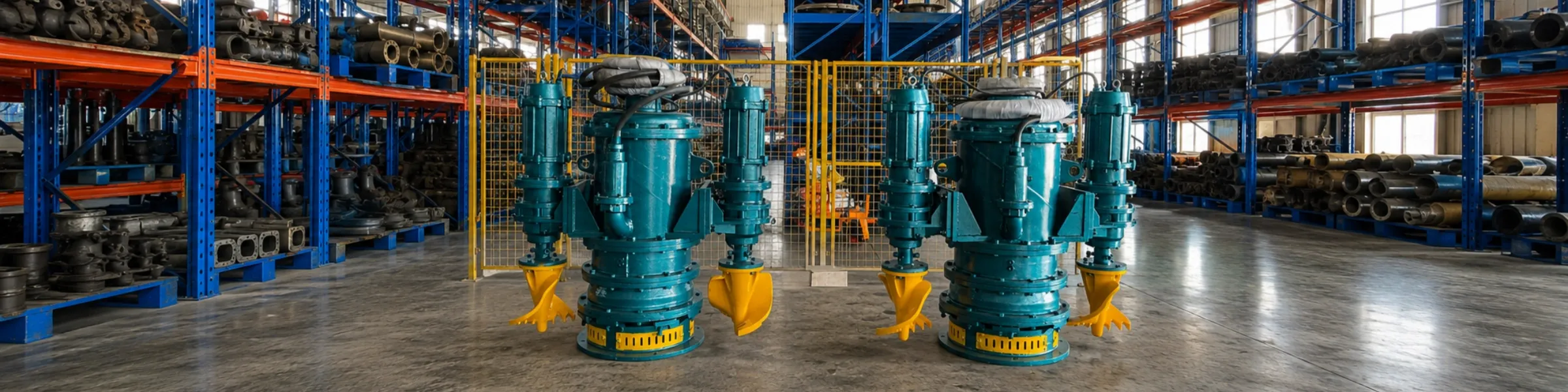
Air-Isolated, Unattended Submersible Sand Pump — SP(B)Q
The SP(B)Q amphibious sand pump runs unattended and continuously: flow 30–2000 m³/h, head 6–260 m, power 3–315 kW, particle 7–60 mm, medium ≤40 °C, max pressure 1.0/1.6 MPa.
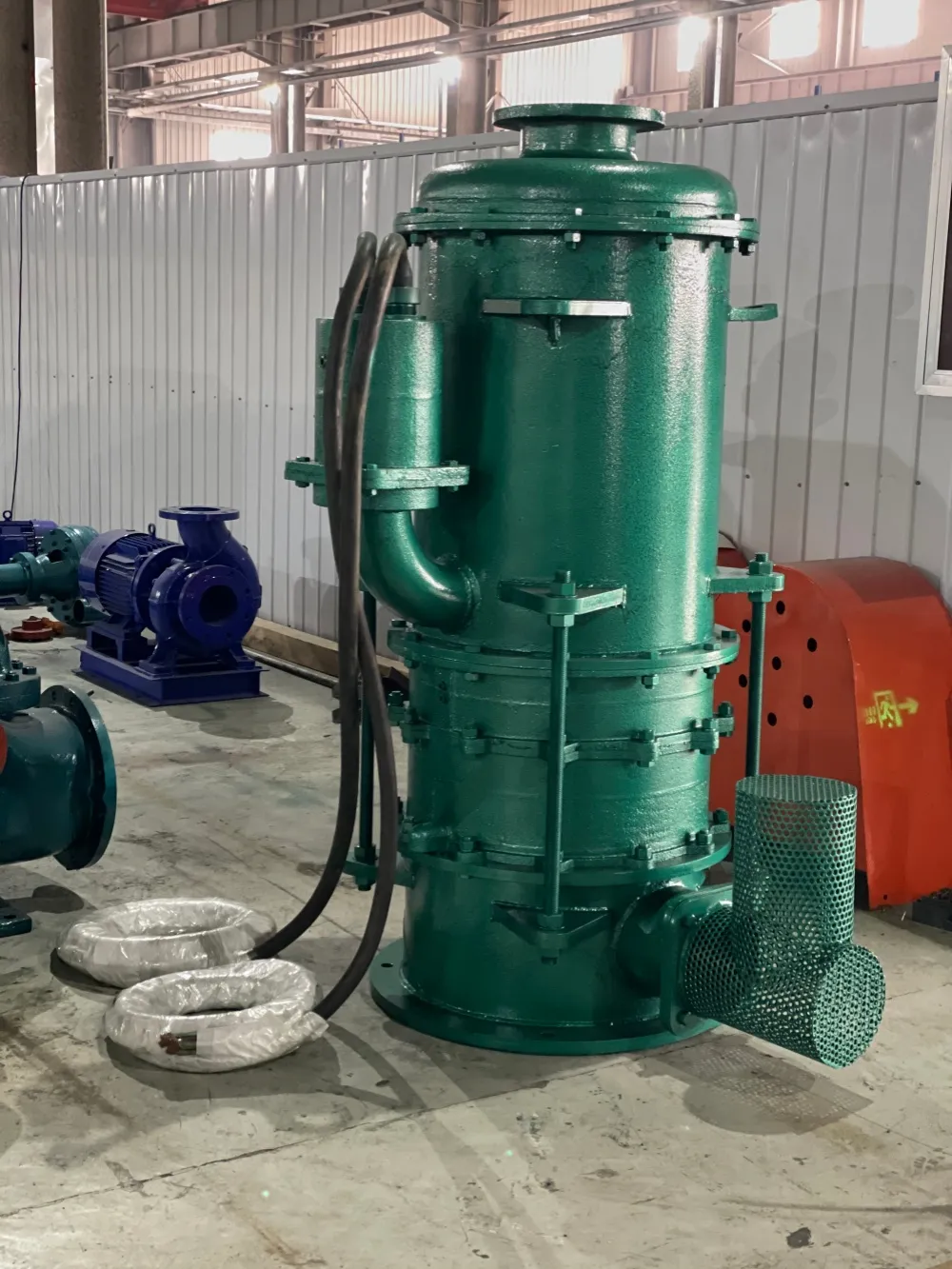
Air-isolated unattended submersible sand pump — a vented guide body expels gas from the impeller zone and a sealed medium-cooled motor removes the two failure modes that normally require an operator on site.
- Independently designed and developed by us, under eight patents
- Discharge 65–400 mm; flow 30–2000 m³/h; head 6–260 m; power 3–315 kW
- Semi-open impeller passes solids to 60 mm at high concentration
- High-chrome alloy wet end for sand, cinder and tailings
- Four installation methods; fixed dry installation requires a cooling system
- Flange dimensions to GB/1724.16-2022
CE · EAC · ISO 9001 · ISO 14001 · ISO 45001
Overview
The SP(B)Q amphibious submersible sand pump is a single-stage, single-suction vertical centrifugal pump built for continuous duty in sand, cinder and tailings service. It is a design developed in-house by SHANGLISHI PUMP GROUP, manufacturer of heavy-duty slurry and sand handling pumps since 1994, and is protected by two utility model patents.
The pump uses a semi-open impeller together with a vented guide body. A vent hole is machined into the face of the guide body where it meets the impeller blades, so that any gas drawn into the impeller zone is expelled through the vent rather than accumulating. The pumped medium is carried around the outer sleeve of the motor, cooling the motor while keeping it sealed against ingress. Together these two features let the unit run without an operator in attendance and without the gas-lock and motor-flooding shutdowns that normally limit submerged sand pumps.
Both features are covered by our own patents — eight in total, listed in full below.
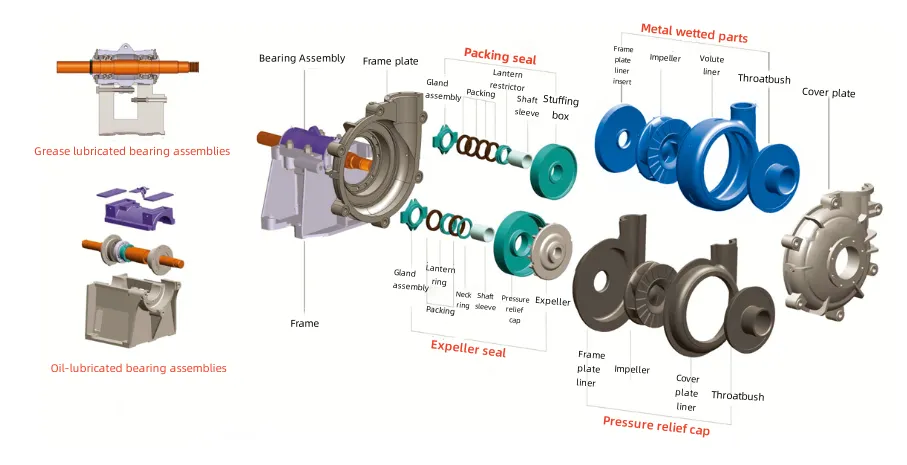
Component callouts — wet end and seal arrangements
- Metal wetted parts — frame plate liner, impeller, volute liner, throatbush, cover plate liner
- Packing seal — bearing assembly, frame plate, lantern ring, grease restrictor, gland assembly, packing, shaft sleeve, stuffing box
- Expeller seal — gland assembly, neck ring, packing, shaft sleeve, pressure relief cap, expeller
- Bearing builds — grease-lubricated and oil-lubricated bearing assemblies
How Unattended Operation Is Achieved
1. Gas isolation structure — vented guide body
Vent holes are integrated into the mating surface between the impeller blades and the guide body. When air or gas enters the impeller zone, it is discharged automatically through those vents. The pump therefore does not gas-lock, and flow is maintained through fluctuating suction conditions and entrained air pockets without manual intervention.
2. Sealed, medium-cooled motor — sealed chamber design
The motor sits in a sealed chamber. Pumped liquid flows around the outer sleeve of that chamber and carries heat away, so the motor runs dry and flood-proof while fully submerged. No separate cooling circuit or supervision is required in wet-pit service.
3. Non-clogging hydraulics
The semi-open impeller and wide flow passages pass solids up to 60 mm and tolerate high solids concentration, which removes the most common cause of unplanned stoppages in sand and dredge duty.
Operational Benefits
- Lower attendance requirement — the unit does not need an operator standing by to clear gas lock, overheating or blockages, which matters most at remote dredging sites and deep sumps.
- Continuous duty — dredging, dewatering and slurry transfer can run without the stop-start cycle caused by gas ingestion or minor blockage.
- Fewer interventions — gas isolation and flood-proof cooling remove two of the principal failure modes, so service intervals can be extended.
- Simpler servicing — the compact arrangement is accessible with basic tools for routine inspection.
- Improved site safety — fewer trips into pits, unstable dredge platforms and confined spaces for pump checks and restarts.
- Deployment flexibility — suitable for locations where a permanent human presence is impractical or unsafe.
Design Advantages
- Deep submergence — the pump operates fully submerged, suiting underwater sand dredging and excavation work.
- Reduced cavitation risk — because the pump is always flooded, suction conditions are stable.
- High solids capacity — sustained operation at solids concentrations that block many surface-mounted alternatives.
- High-chrome alloy wet end — resists wear from sand, cinder and tailings.
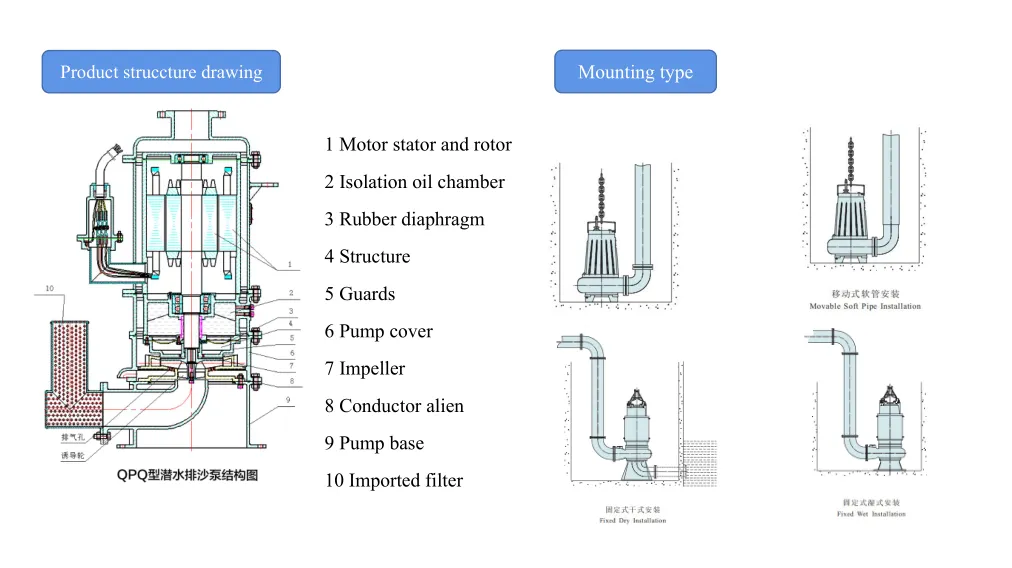
Principal Components
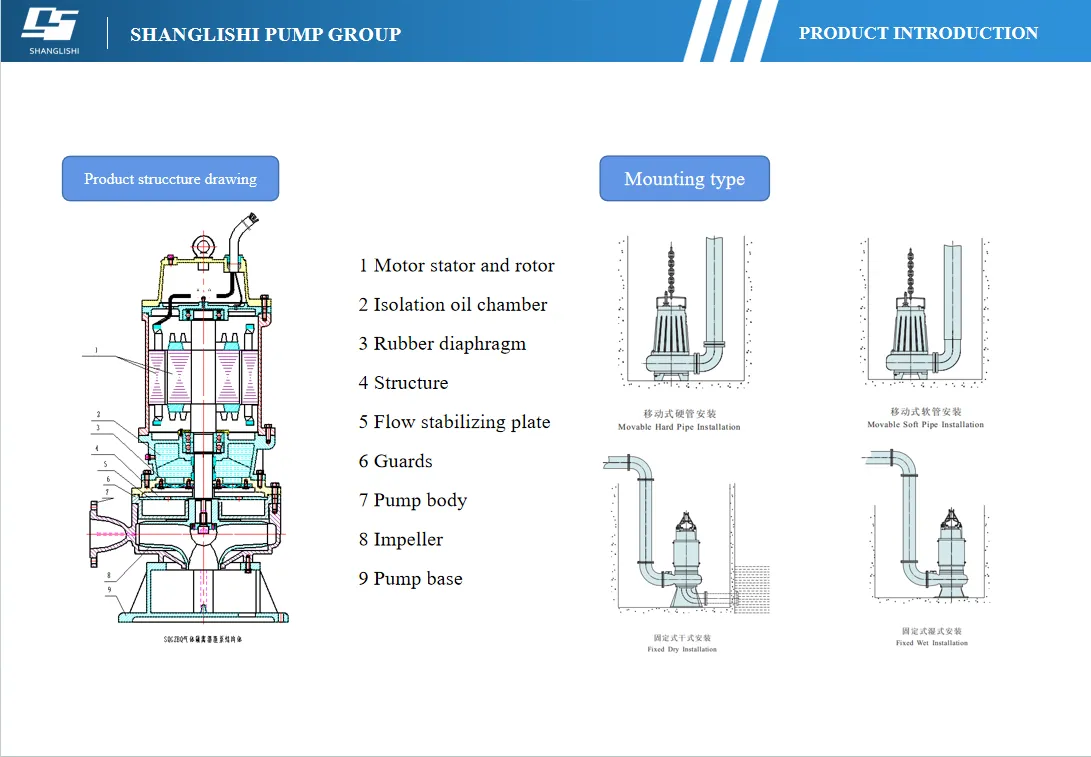
| 1 | Motor stator and rotor | 7 | Impeller |
|---|---|---|---|
| 2 | Isolated oil chamber | 8 | Guide body |
| 3 | Rubber diaphragm | 9 | Pump seat |
| 4 | Gas isolation structure | 10 | Inlet filter screen |
| 5 | Guard | 11 | Vent hole |
| 6 | Pump cover | 12 | Inducer |
Installation Methods
- Mobile hard-pipe installation — the pump rests on its base and a hard-pipe joint connects it to the pipework.
- Mobile hose installation — the pump rests on its base with a hose connector to the discharge hose, so the unit can be moved between sumps.
- Fixed dry installation — flanged suction and discharge, vertical mounting, suitable for wet or dry well pipework and able to withstand flooding. A cooling system is required with this arrangement.
- Fixed wet installation — base-supported and fixed at the bottom of the sump, vertical mounting with piped or hose discharge.
Typical Applications
- Mining — recovering sand and minerals from submerged deposits; discharge of solids-bearing media in mine construction.
- Dredging — sand removal from riverbeds, lakes and other water bodies.
- Construction — slurry and sand transfer on tunnelling and foundation works.
- Oil and gas — drilling mud handling and sand removal.
- Municipal and industrial drainage — urban drainage and sewage duty, including hospital, hotel and residential developments.
- Irrigation and river dredging — irrigation supply and sand discharge duty.
Customised Configurations
Impeller geometry, wet-end material and motor selection can be adapted to the duty. Send us the flow, head, medium, particle size and solids concentration and we will confirm the configuration and model for your application.
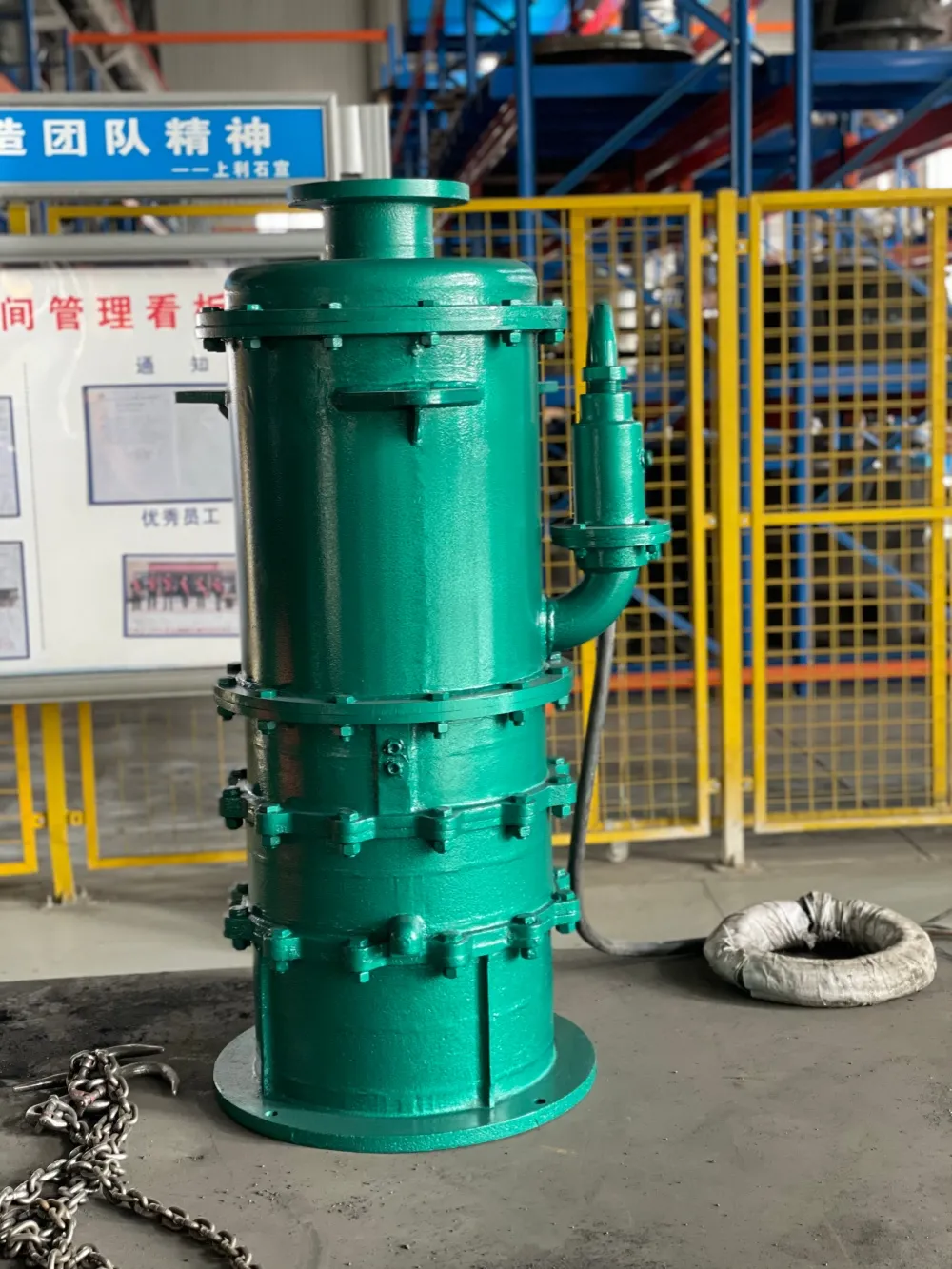
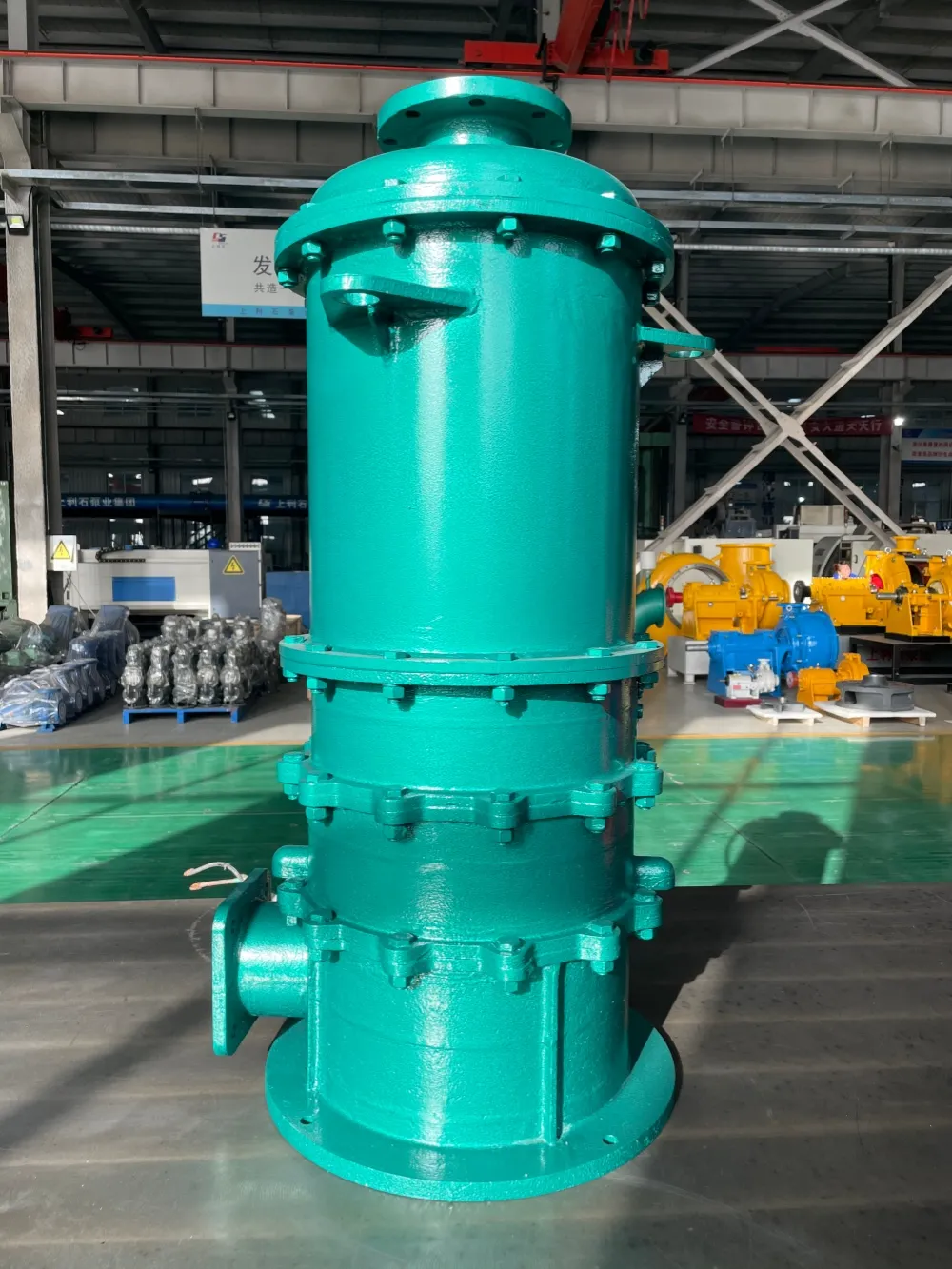
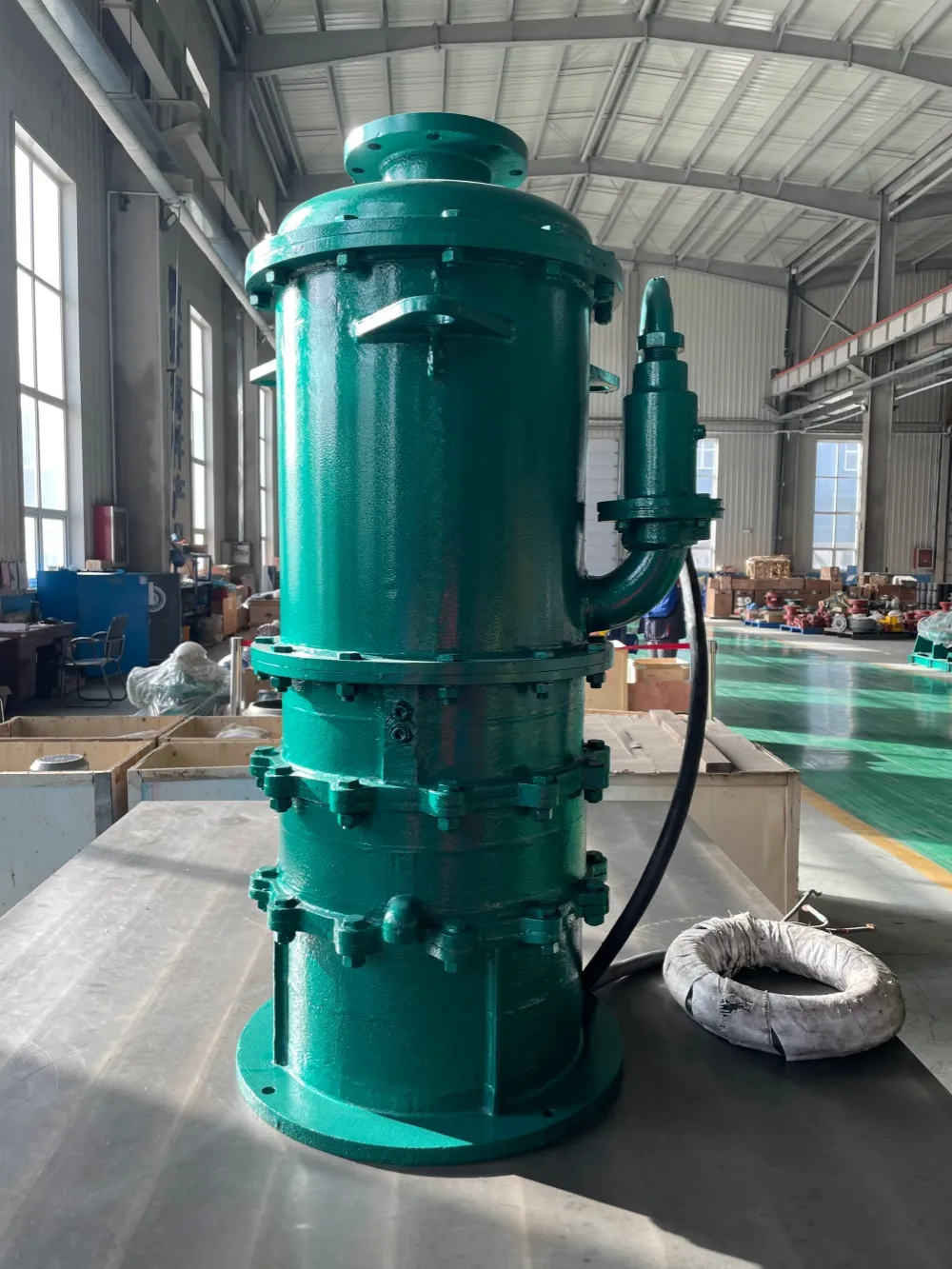
More Pictures
Patents
The SP(B)Q gas-isolated amphibious submersible sand pump is a product independently designed and developed by SHANGLISHI PUMP GROUP, covered by the following patents:
| 1 | ZL202410267654.4 |
|---|---|
| 2 | ZL202322736696.1 |
| 3 | ZL202322479532.5 |
| 4 | ZL202223350718.2 |
| 5 | ZL202123054344.5 |
| 6 | ZL202123102801.3 |
| 7 | ZL202121916374.X |
| 8 | ZL202320525781.0 |
Send Your Enquiry
| Inlet / outlet diameter | 65–400 mm (flange dimensions to GB/1724.16-2022) |
|---|---|
| Flow range | 30–2000 m³/h |
| Head range | 6–260 m |
| Speed | 720, 990, 1480 and 2960 r/min |
| Power | 3–315 kW |
| Temperature | Maximum liquid temperature ≤ 40 °C |
| Maximum working pressure | 1.0 MPa(G) for Hsp ≤ 75 m; 1.6 MPa(G) for Hsp > 75 m. Special configurations to 1.6 MPa(G) or 2.5 MPa(G) respectively |
| Wet-end material | High-chrome alloy |
| Medium | Liquids carrying solid particles such as sand, cinder and tailings; maximum particle size 7–60 mm (see technical specification for the individual model) |
| Structure | Single-stage single-suction centrifugal, vertical installation |
Can the pump run without an operator in attendance?
Yes. The vented guide body expels gas from the impeller zone instead of allowing it to accumulate, and the motor is sealed and cooled by the pumped medium. The two features together remove the gas-lock and motor-flooding shutdowns that normally require an operator on site.
What particle size and solids content can it handle?
Maximum particle size is 7–60 mm depending on model. The semi-open impeller and wide passages are intended for high solids concentrations in sand, cinder and tailings duty. Send us your particle size distribution and solids concentration and we will confirm the model.
Which installation arrangement should we use?
Four arrangements are available: mobile hard-pipe, mobile hose, fixed dry and fixed wet. Fixed dry installation requires a cooling system. Mobile arrangements suit sites where the pump is moved between sumps.
Do you supply model-by-model performance data and curves?
Full model-by-model performance data and selection curves are issued with the quotation. Send the required flow, head, medium, particle size, specific gravity, voltage and frequency and we will return a selection with the matching curve.
What materials are available for the wet end?
The standard wet end is high-chrome alloy. Alternative wet-end materials and impeller geometries can be quoted against the duty.
Manufacturer-direct supply · Technical pump-selection support · Export documentation on request.