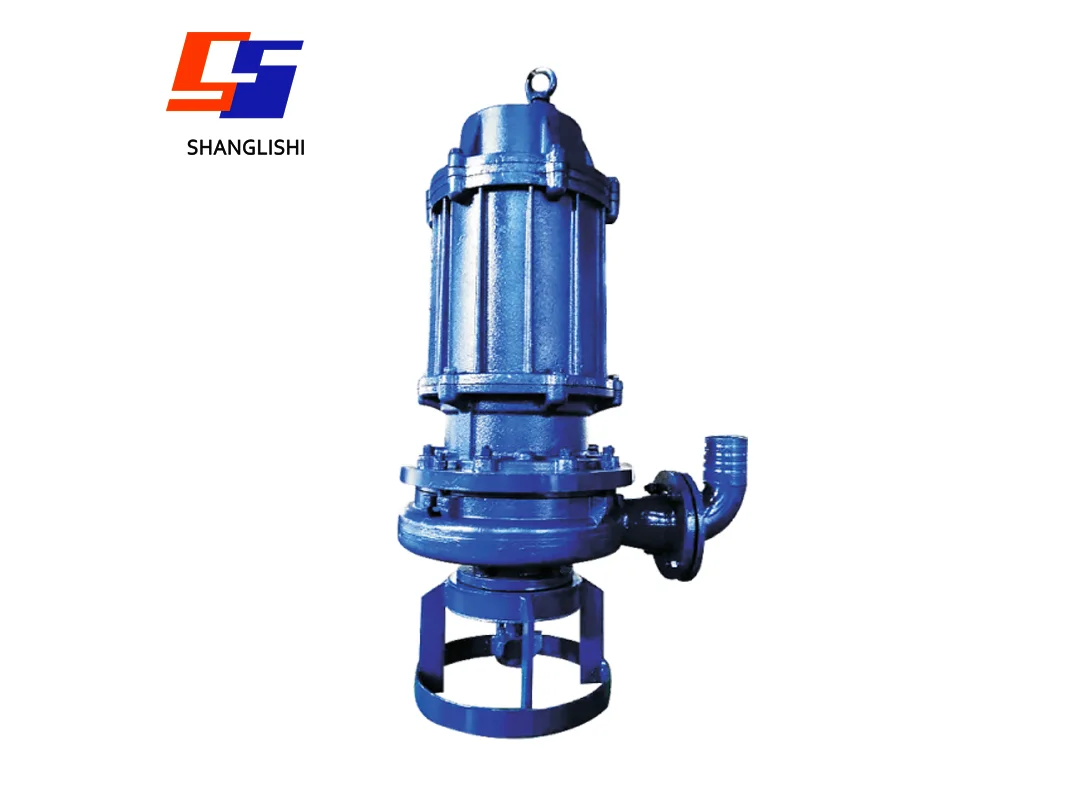
Heavy-Duty Submersible Wastewater Pump
SWQ heavy-duty wastewater pump for industrial mud, mixed and drainage water; flow to 4000 m³/h, solids not exceeding 50 % of the outlet diameter, IPX8 Class-F (155 °C).
Heavy-duty wastewater service — continuous operation on media combining solids, fibre and abrasion, in a wet well that cannot be taken out of service.
- SKF or NTN bearings sized for solids-handling radial and axial loads
- Class F insulation to 155 °C, IPX8 enclosure
- Built-in cooling circuit — runs with the motor above or below liquid level
- Two seals in series: WC/WC pump side, graphite/SiC motor side
- Five monitored parameters including cable-gland seal from 30 kW upward
- Five installation arrangements; automatic coupling gives the lowest service cost
CE · EAC · ISO 9001 · ISO 14001 · ISO 45001
Overview
Heavy-duty wastewater service means continuous operation on media that combine solids, fibre and abrasion, usually in a wet well that cannot be taken out of service. The SWQ series is specified for this duty with imported bearings, a two-stage sealing arrangement, a built-in cooling circuit and a monitoring package that stops the unit before a fault becomes motor damage.
Working conditions
| Inlet / outlet diameter | 50–600 mm |
|---|---|
| Flow range | 15–4000 m³/h |
| Head range | 7–40 m |
| Speed | 720, 990, 1480 and 2960 r/min |
| Motor power | 0.75–315 kW |
| Temperature range | Medium temperature ≤ 40 °C; medium density ≤ 1200 kg/m³; pH 5–9 |
| Maximum working pressure | Inlet pressure + pumping pressure: 1.0 MPa(G) for Hsp ≤ 75 m, or 1.6 MPa(G) for Hsp > 75 m. Special configuration to 1.6 MPa(G) or 2.5 MPa(G) |
| Material | Cast iron, SS304, SS316 |
| Medium | Wastewater with solid particles and long fibres, sewage, rainwater |
| Structural design | Single-stage single-suction centrifugal pump, vertical mounting |
Model designation
Example: 50SWQ15-8-0.75
| 50 | Drain aperture in millimetres |
|---|---|
| SWQ | Submersible sewage pump |
| 15 | Capacity, m³/h |
| 8 | Head, m |
| 0.75 | Power of fitted motor, kW |
Construction
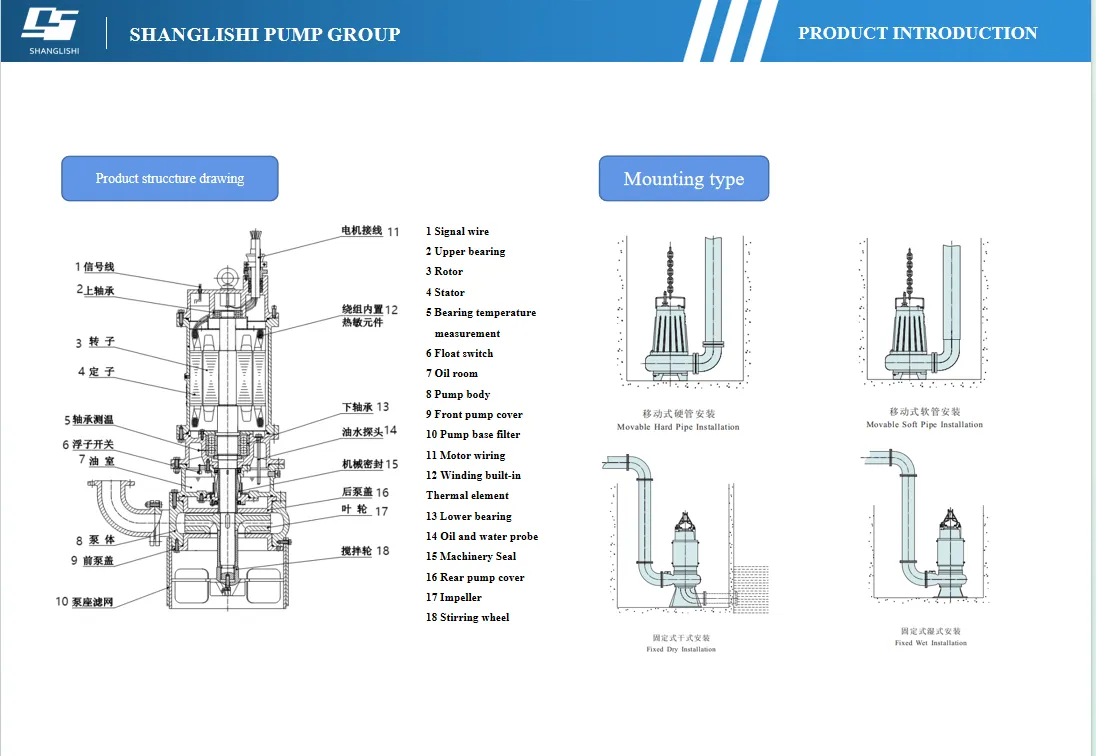
- Bearings — SKF or NTN, arranged and sized for the radial and axial loading of solids-handling duty.
- Motor — class F insulation with a maximum working temperature of 155 °C, IPX8 enclosure.
- Cooling — built-in circuit drawing a portion of the pumped liquid through the cooling cylinder and casing, so the unit runs with the motor above or below liquid level. The cooling jacket can be separated and connected to an external cooling system where duty requires.
- Casing — profile developed and machined by CAD/CAM to hold the modelled flow path.
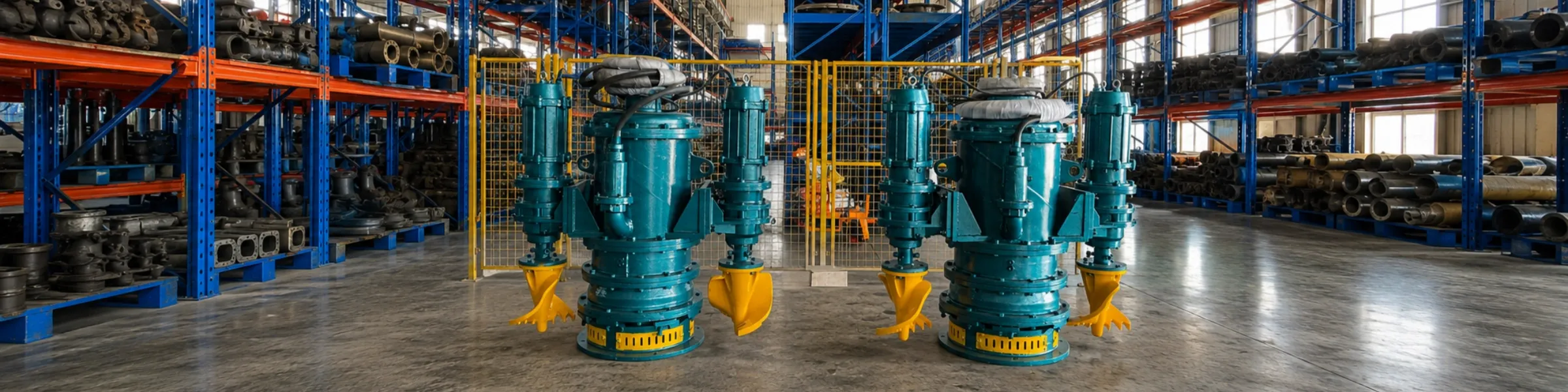
- Impeller — single-vane, two-vane or three-vane, selected against the medium; each duty has a matching impeller rather than one standard fit.
Two-Stage Sealing
Two mechanical seals are connected in series and work independently, so the motor is isolated from the medium by two barriers. The pump-side seal runs tungsten carbide against tungsten carbide; the motor-side seal runs graphite against silicon carbide. The oil chamber between them lubricates and cools both faces and prevents liquid penetrating to the motor, and a volume of air is retained in the chamber to limit pressure rise.
Monitoring Package
- Stator temperature — three thermal switches in series embedded in the stator, normally open at ambient, opening at 125 °C.
- Oil-chamber leakage — a probe detects pump-side seal leakage; when the oil-water ratio reaches the set concentration an indicator is raised, power is cut and the pump stops. Service action is to renew the oil and check, and if necessary replace, the pump-side seal.
- Motor-cavity water — a float switch raises a warning when liquid entering the switch chamber reaches the set height, indicating motor-side seal leakage.
- Cable gland — from 30 kW upward, a leakage probe in the motor terminal box checks the cable seal.
- Bearing temperature — monitored to detect developing bearing failure.
Installation Options
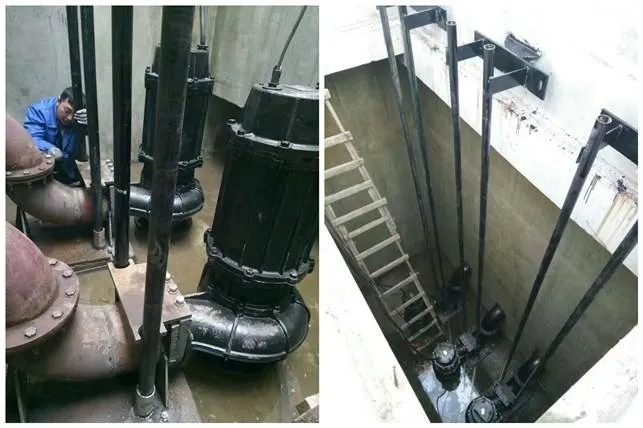
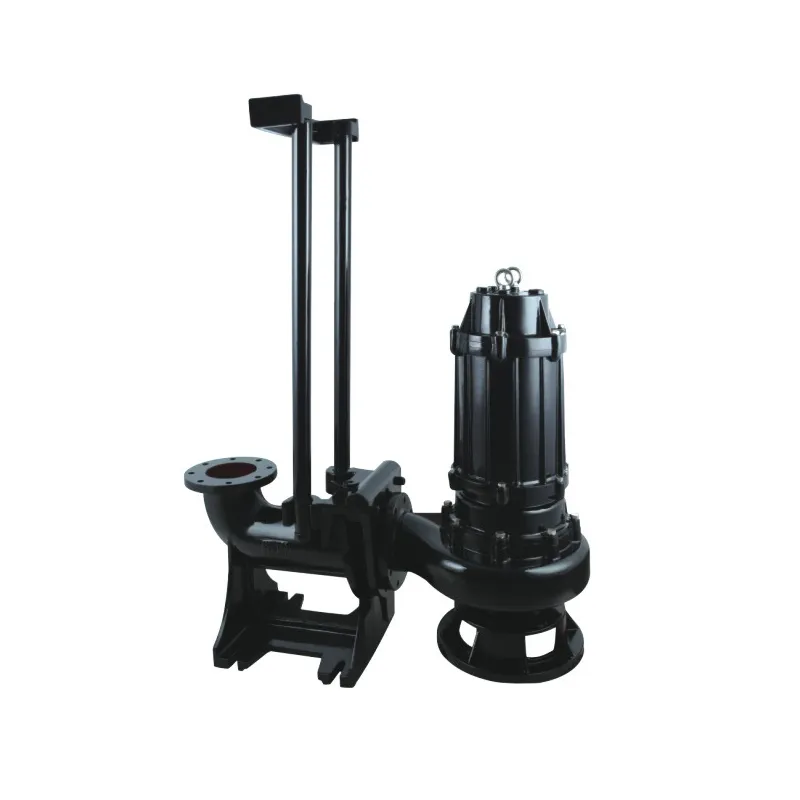
Five arrangements: automatic coupling on a guide rod, where the pump lowers into position and connects automatically to the discharge pipework, keeping installation and later service simple; mobile hard pipe; mobile hose, allowing one unit to serve several wells; fixed dry installation, flanged suction and discharge, vertical, able to withstand flooding and requiring a cooling system; and fixed wet installation, base-supported on the well floor with piped discharge.
Typical Applications
- Municipal wastewater pumping stations in continuous duty.
- Industrial effluent with high solids and fibre loading.
- Sewage treatment works — sediment, recirculation and screenings duty.
- Corrosive and high-temperature effluent to 40 °C.
- Viscous sludge transfer.
- Building, tunnel, dam and land drainage.
Selection
Provide the flow and head, the medium with its solids and fibre content and temperature, the well geometry and level range, and the available power supply. We will confirm the model, impeller form, installation arrangement and monitoring configuration with the quotation.
Send Your Enquiry
| Series | SWQ submersible sewage pump |
|---|---|
| Maximum solid size | 50 mm diameter |
| Flow | To 4000 m³/h |
| Medium temperature | Up to 40 °C |
| Motor insulation | Class F, maximum working temperature 155 °C |
| Motor enclosure | IPX8 |
| Bearings | SKF or NTN |
| Mechanical seal | Two seals in series, working independently. Pump side tungsten carbide / tungsten carbide; motor side graphite / silicon carbide |
| Impeller options | Single-vane, two-vane or three-vane, selected against the duty |
| Stator thermal protection | Three thermal switches in series embedded in the stator, normally open, opening at 125 °C stator temperature |
| Leak detection | Oil-chamber leakage probe with alarm and automatic shutdown; cable-gland leakage probe fitted in the motor terminal box from 30 kW upward |
| Installation | Five arrangements: automatic coupling, mobile hard pipe, mobile hose, fixed dry, fixed wet |
What protects the motor in continuous heavy-duty service?
Two seals in series with an oil chamber between them, plus independent monitoring of stator temperature, oil-chamber leakage, motor-cavity water, bearing temperature and, from 30 kW upward, the cable gland seal.
Can the pump run with the motor out of the liquid?
Yes. The built-in cooling circuit draws pumped liquid through the cooling cylinder and casing, so operation is not dependent on submergence of the motor. An external cooling circuit can be connected where duty requires.
What medium temperature is acceptable?
Up to 40 °C. Motor insulation is class F with a maximum working temperature of 155 °C.
Which installation arrangement gives the lowest service cost?
Automatic coupling on a guide rod. The pump seats and connects to the discharge automatically, so it can be removed and replaced without breaking pipework or draining the well.
Manufacturer-direct supply · Technical pump-selection support · Export documentation on request.