
How Does a Dredge Pump Work? A Practical Guide
A dredge pump is a heavy-duty centrifugal slurry pump that draws solids-laden water (sand, gravel, sediment) through a wide flow passage and moves it via an impeller to the discharge point.
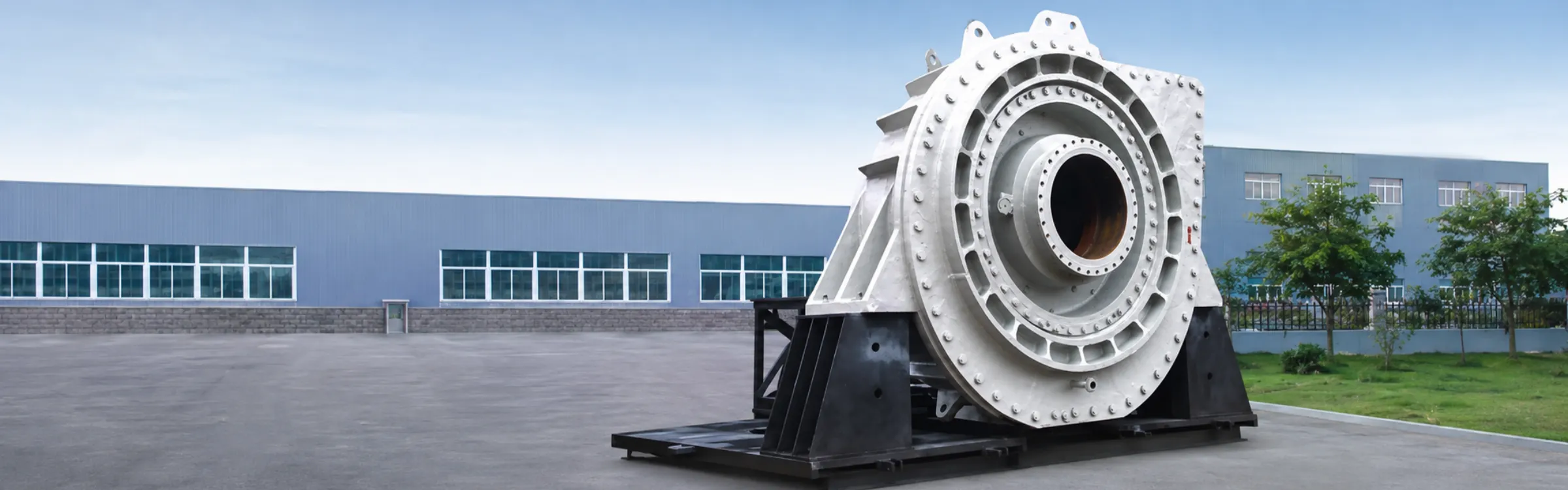
A dredge pump is a centrifugal pump built around one problem — moving a mixture of water and coarse solids that a normal pump would block on, from a source that is often below the pump and constantly changing.
- Single-casing construction — no liner to break on cobbles
- Full wall thickness serves as wear material
- Wide-passage impeller sized against the largest solid
- Discharge rotatable to any orientation for vessel geometry
- Selection starts with particle size, not with the duty point
- A22 casings, A23 components, A25 where weld repair matters
CE · EAC · ISO 9001 · ISO 14001 · ISO 45001
Working Principle, Step by Step
- Material is loosened at the bed. Sand and silt may flow on their own; consolidated material needs a cutter head or an agitator to break it down first. This step is outside the pump but decides whether the pump can work at all.
- The mixture enters the suction. Water carries the loosened solids toward the intake. Suction line length and geometry matter here: a long or convoluted line loses the mixture before it arrives.
- The impeller adds energy. The rotating impeller accelerates the mixture outward. Because the solids are coarse, the passages are wide and the vane count is low — free passage matters more than hydraulic refinement.
- The volute converts velocity to pressure. The casing collects the flow and converts velocity into the discharge pressure that pushes the mixture along the pipeline.
- The pipeline carries the mixture away. Pipeline velocity must stay above the settling limit for the coarsest particles. Below it the solids drop out in the line — and a settled pipeline is harder to clear than a blocked pump.
Why the Construction Is Different
A lined slurry pump has a replaceable wear shell inside a pressure casing. A dredge pump does not, and that is deliberate. On gravel and cobble duty a liner is broken rather than worn, and once broken the load passes to an outer shell never designed to carry it. Single-casing construction puts the full wall thickness in wear-resistant metal instead, so there is no thin element to fail.
Casing and cover are joined by a clamping arrangement rather than a bolted flange, which allows the discharge to be rotated to any orientation. On a dredge or a pontoon, where the discharge geometry is fixed by the vessel rather than by the pump, that is what makes installation practical.
Key Components
| Casing | Cast in wear-resistant metal; the full wall is wear material. A22 anti-wear cast steel (1200 MPa, HRC45) is specified for dredge duty |
|---|---|
| Impeller | Wide passages and low vane count for maximum free passage; balanced to limit vibration |
| Cover | Clamped rather than bolted, allowing discharge rotation |
| Shaft and bearings | Large shaft diameter with short overhang to resist deflection under heavy intermittent loading |
| Shaft seal | Expeller, packing or mechanical, selected against inlet pressure and gland water availability |
| Drive | Electric motor or internal combustion engine; speed control valuable where concentration varies |
How Selection Actually Works
Dredge pump selection runs in a different order from process pump selection, and getting the order wrong is the most common mistake.
- Largest solid first. It sets the minimum pump size. A pump selected on flow and head that ignores particle size will block on the first oversize stone — and on a dredge that is a shift lost, not a maintenance item.
- Then concentration and density. The head the pump must generate scales with mixture density.
- Then the pipeline. Calculate loss at the design velocity over the full line, including any floating section, and check both the shortest and longest configuration the job will use.
- Only then the duty point. Flow and head become meaningful once the first three are fixed.
Reading the Symptoms
- Discharge pressure falling at unchanged speed and concentration — wear at the impeller and casing, not a change in the material.
- Production dropping while the cutter is working normally — check pipeline velocity before blaming the pump; solids may be settling in the line.
- Frequent blockage — the pump is undersized for the largest solid reaching the suction, or the agitation is not keeping up.
- Suction breaking as the ladder lifts — arrange priming rather than relying on the pump to recover.
Choosing the Wear Material
A22 anti-wear cast steel (1200 MPa, HRC45) for dredge pump casings; A23 (HB500–600) for high-erosion components; A05 high-chrome white iron (≥HRC62) for high-impact abrasive wear at pH 5–12. Where a damaged casting cannot leave site, consider A25 (HB300–350) — softer, but weldable, so field repair is possible. On a remote operation that can be worth more than the last increment of hardness.
Send Your Enquiry
Why does a dredge pump have no liner?
On gravel and cobble duty a liner is broken rather than worn, and the load then passes to a shell never designed to carry it. Single-casing construction puts the full wall thickness in wear-resistant metal instead.
What decides the pump size?
The largest solid reaching the suction, before flow and head. A pump selected on duty point alone blocks on the first oversize stone.
Why does pipeline velocity matter so much?
Below the settling velocity for the coarsest fraction the solids drop out in the line. A settled pipeline is considerably harder to clear than a blocked pump.
Discharge pressure is falling — is the material harder than expected?
If speed and concentration are unchanged, falling discharge pressure points to wear at the impeller and casing rather than to the material.
Can the discharge orientation be changed on site?
Yes. Casing and cover are joined by a clamping arrangement and the discharge rotates to any orientation, which matters where the geometry is fixed by the vessel.
Manufacturer-direct supply · Technical pump-selection support · Export documentation on request.