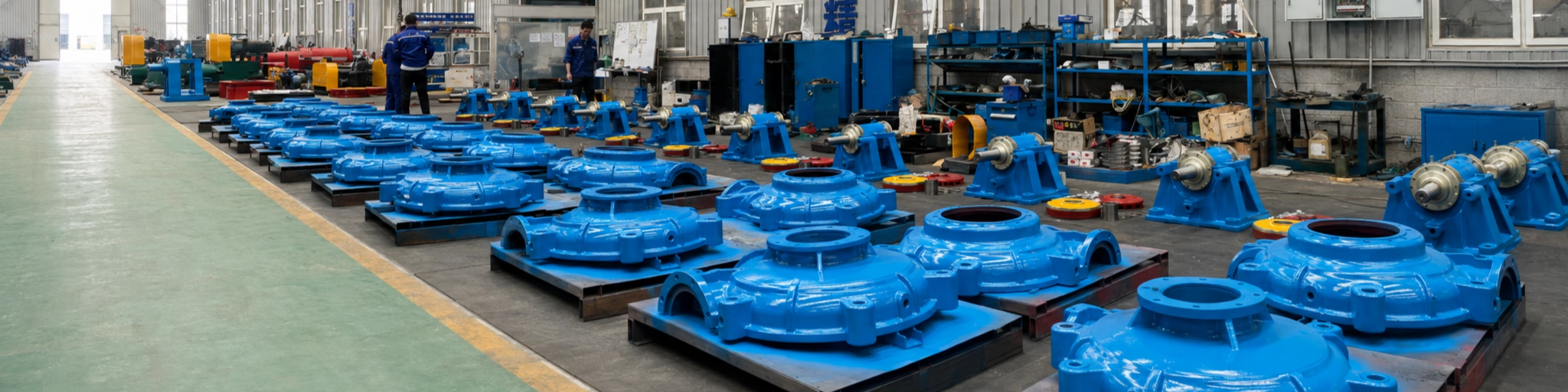
Slurry Pump Liners & Volute Casings
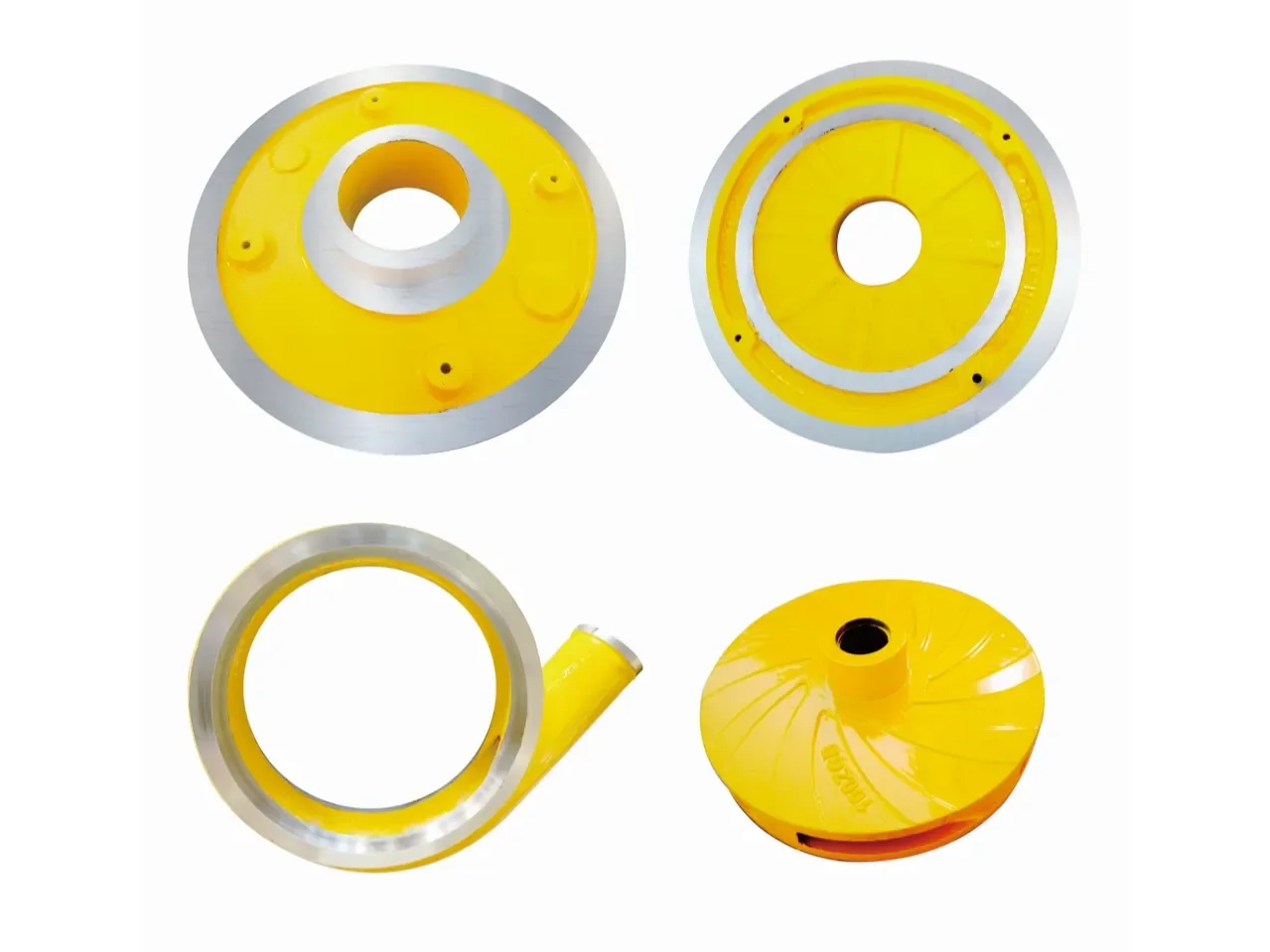
Replaceable volute liners, throatbushes and frame-plate/cover-plate liners protect the casing from abrasion and are matched to the pump model.
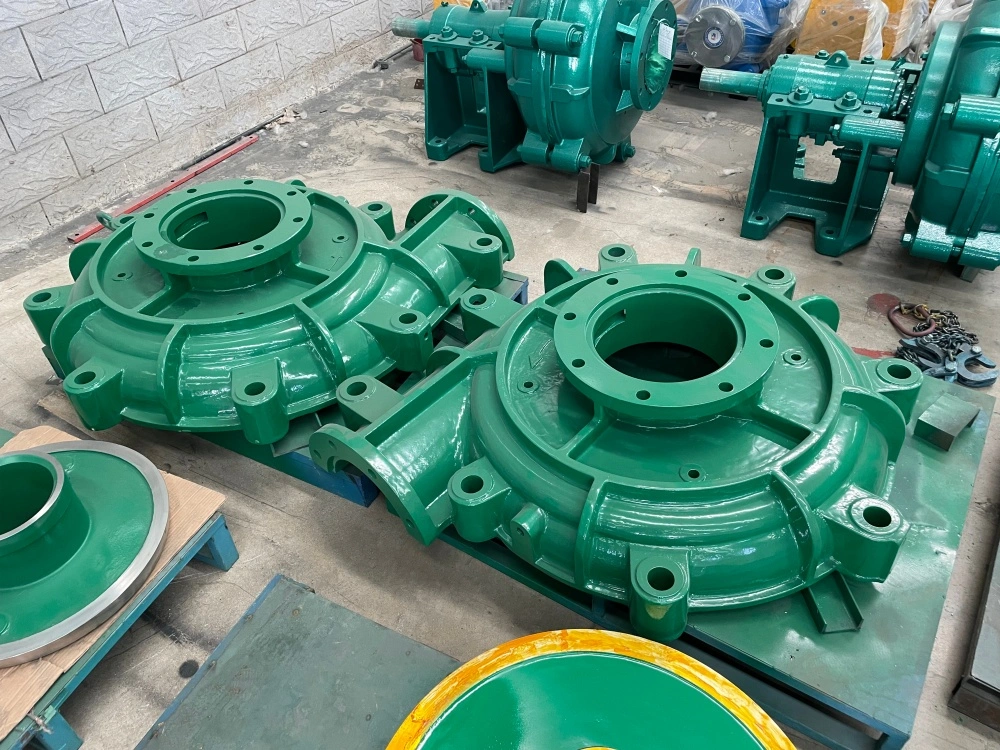
Volute liners, throatbushes and casing liners — in a double-casing pump the liners take all the wear and the outer body only contains pressure, so as-new clearances are restored by changing wear parts rather than the casing.
- Five replaceable elements: volute liner, throatbush, frame plate liner insert, cover plate liner, frame plate
- Metal, rubber and polyurethane liner sets share the same pressure casing
- Move between metal and rubber wet ends without altering pump, baseplate or drive
- Throatbush normally wears first — inlet velocity is highest there
- Wear elsewhere first usually indicates operation away from best-efficiency point
- Gravel pumps are the exception: single-casing, no liner
CE · EAC · ISO 9001 · ISO 14001 · ISO 45001
Overview
In a double-casing slurry pump the volute liner and casing liners take all the wear, and the outer body only contains pressure. That separation is the reason a heavy-duty slurry pump can be run to the end of the liner life and then returned to as-new clearances by changing wear parts rather than the casing.
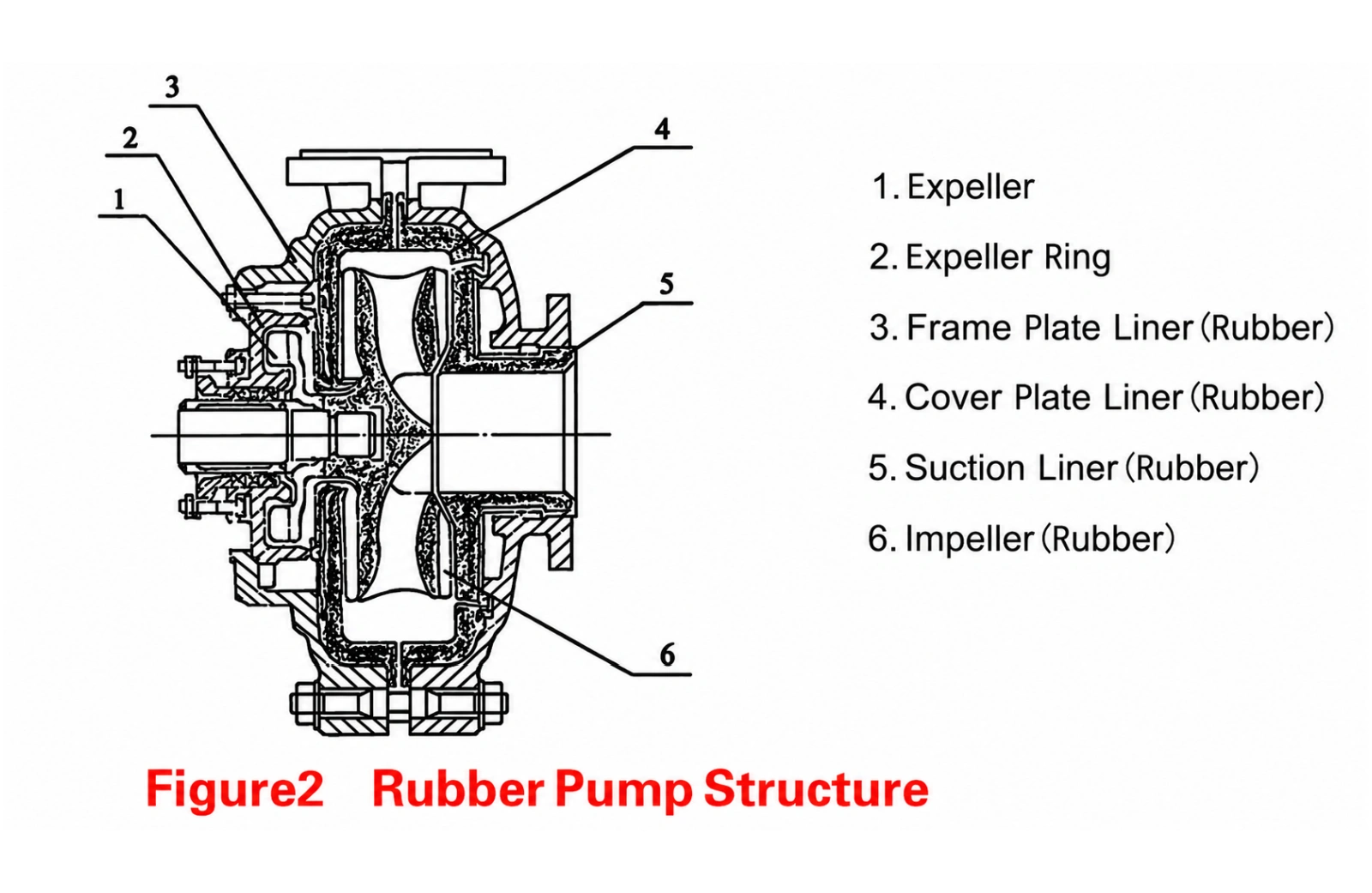
The Wear-Part Set
A metal-lined heavy-duty pump carries the following replaceable elements inside the body and cover:
- Volute liner — the wear shell that forms the volute passage.
- Throatbush (front liner) — at the suction side of the impeller, where inlet velocity is highest.
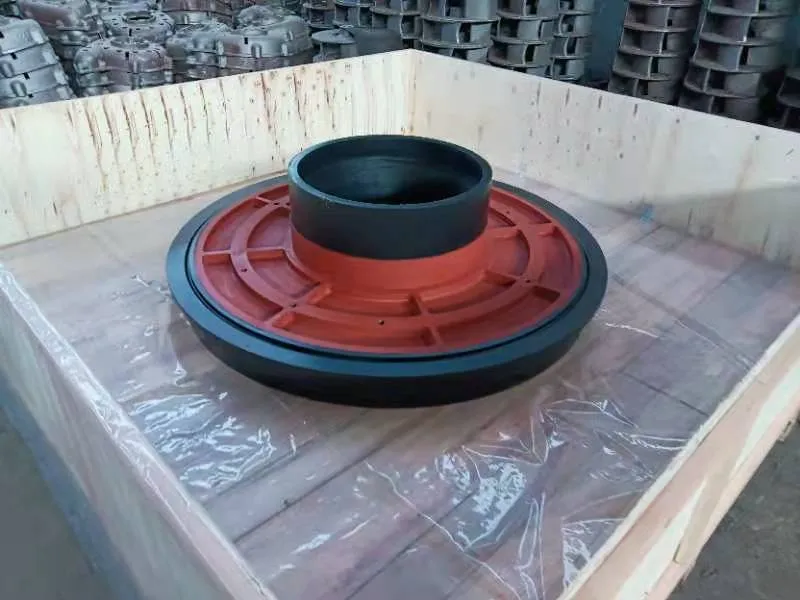
- Frame plate liner insert (rear liner) — behind the impeller on the drive side.
- Cover plate liner — protecting the cover face.
- Frame plate — carrying the rear liner and locating against the bracket.
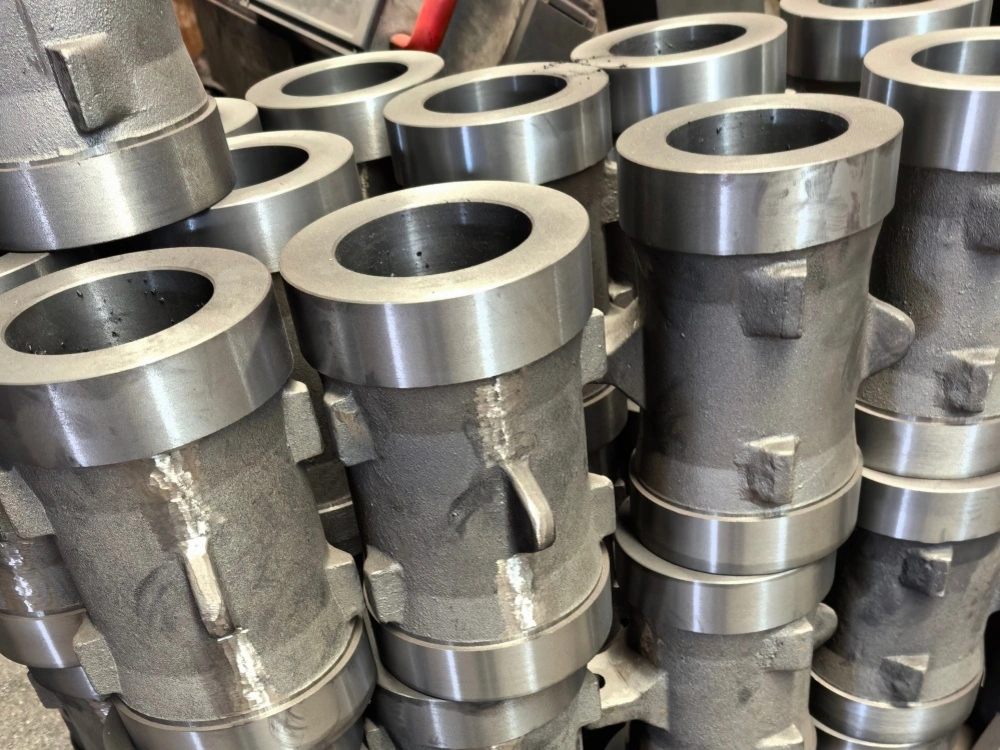
Body and cover are cast in grey iron or ductile iron according to working pressure, split vertically and bolted, with the body bolted to the bracket against a stop. The liner set is held by bolts and a fixed pressure plate against the body.
Metal, Rubber and Polyurethane Liner Sets
The same double-casing arrangement accepts three liner families, and the body, cover, transmission parts and mounting form are common between them:
- Metal liners — high-chrome white iron for coarse, angular and high-impact duty.
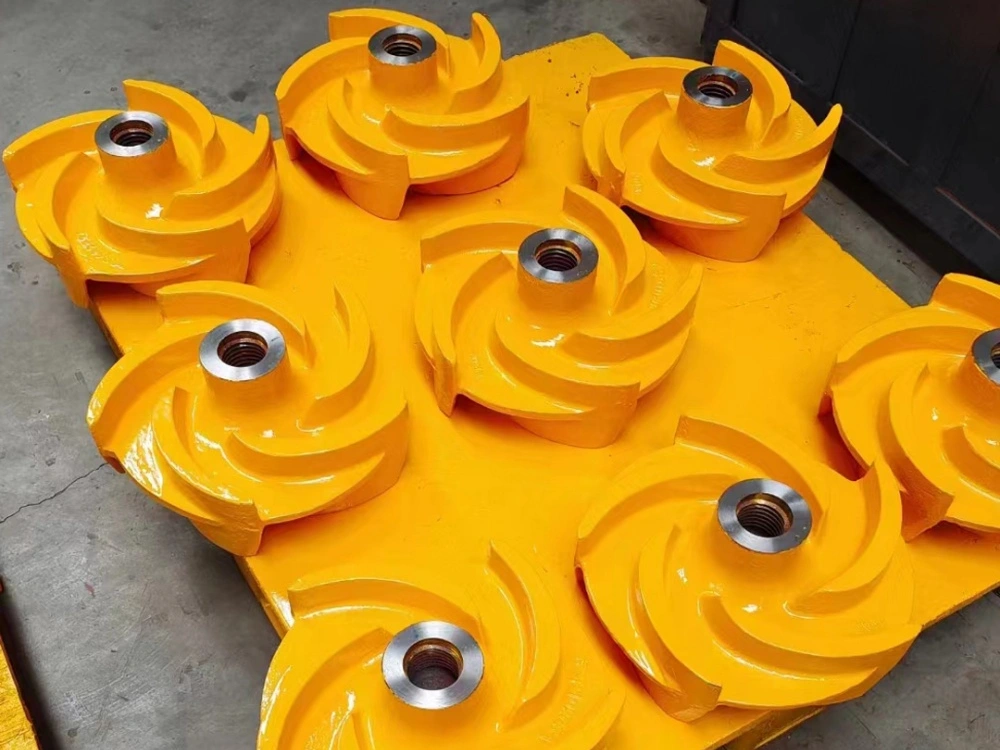
- Rubber liners — wear- and corrosion-resistant elastomer, including front and rear liners and rubber impeller, for fine high-concentration slurry without sharp angular particles.
- Polyurethane liners — for fine abrasive slurry in sliding-wear duty.
Because the pressure casing is unchanged, a site can move between metal and rubber wet ends as ore or duty changes without altering the pump, the baseplate or the drive.
Material Grades
| Grade | Designation | Tensile δb (MPa) | Hardness | Application |
|---|---|---|---|---|
| A05 | KmTBCr27 | ≥700 | ≥HRC62 | High-impact abrasive wear, pH 5–12 |
| A07 | KmTBCr15Mo | ≥550 | ≥HRC59 | Best erosion resistance where impact is lower |
| A49 | Anti-corrosive iron | ≥600 | HRC43 | Low-pH duty, pH ≥4, including flue-gas service |
| Rubber | Natural / synthetic elastomer | — | — | Fine, high-concentration abrasive slurry without sharp angular particles |
| Polyurethane | — | — | — | Fine abrasive slurry; sliding wear duty |
| Ceramic | Silicon carbide | — | — | Strong wear plus corrosion duty; separate pump series |
Single-Casing Exception
Gravel pumps are the exception: they are single-casing with no liner at all. Body, cover and impeller are all cast in wear-resistant metal so the full wall thickness serves as wear material, and body and cover are joined by a clamping arrangement that lets the discharge be rotated to any orientation. That construction suits very coarse gravel duty where a liner would be broken rather than worn.
Ordering Liners
Give us the pump model, which elements are being replaced, the material now fitted and the observed wear pattern. Uneven liner wear often points to a duty point away from best efficiency rather than to the liner material, and it is worth checking before repeating the same order. Dimensional data for matching existing installations is available on request.
Send Your Enquiry
Why use a liner instead of a thicker casing?
The liner can be renewed to restore as-new clearances without replacing the pressure casing, and the liner material can be selected for the duty independently of the casing material.
Can we change from metal to rubber liners on an existing pump?
Yes. Body, cover, transmission parts and mounting form are common between the metal-lined, light-duty and rubber-lined builds; only the wet-end elements differ.
Which liner wears first?
Usually the throatbush, because inlet velocity is highest there. Wear elsewhere first is worth investigating — it often indicates the pump is running away from its best-efficiency point.
Do gravel pumps use liners?
No. Gravel pumps are single-casing: casing, cover and impeller are cast in wear-resistant metal with no separate liner.
Manufacturer-direct supply · Technical pump-selection support · Export documentation on request.