
Matching Liner Material to Your Slurry: Metal, Rubber or Polyurethane
Metal, rubber or polyurethane: how particle shape, not hardness alone, decides which liner will last in your duty.
The wet end is where a slurry pump is either worth its price or a running cost. Getting the liner material right for the particles you are actually pumping is the single decision that most affects how long the pump lasts between rebuilds.
Overview
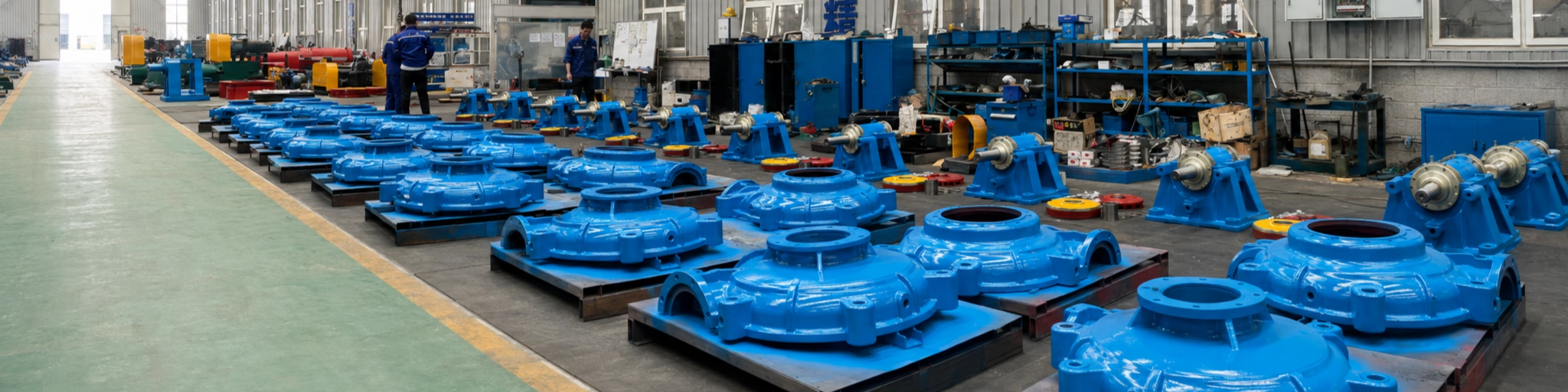
A slurry pump wet end can be built three ways: cast in high-chrome white iron, lined in rubber, or lined in polyurethane. All three sit inside the same pressure casing on our SAH-series pumps, so the same pump, baseplate and drive can carry either a metal or a rubber wet end. That makes the liner a duty decision rather than a pump decision — and it means a plant can change material later without changing the installation.
Start with particle shape, not hardness
The instinct is to reach for the hardest material available. For angular solids that is right. For rounded solids it often is not.
Rubber resists wear by deforming and springing back. A rounded particle striking a rubber liner is absorbed and rebounds, and the liner survives impacts that would erode metal. This is why rubber does well in fine, high-concentration slurry.
Sharp angular particles defeat that mechanism. Instead of bouncing off, they cut the elastomer. Once the surface is nicked, the cut propagates. Angular material of any size, and coarse solids generally, are metal duty.
So the first question is not “how abrasive is this slurry” but “what shape are the particles, and how hard do they hit”.
Where each material belongs
Metal — high-chrome white iron
Coarse, angular or high-impact duty. Our standard wet-end grades:
| Grade | Designation | Hardness | Where it fits |
|---|---|---|---|
| A05 | KmTBCr27 | ≥HRC62 | Higher-impact abrasive wear; duty at pH 5–12, some corrosion resistance |
| A07 | KmTBCr15Mo | ≥HRC59 | Best erosion resistance of the group where erosion dominates |
| A01 | KmTBCr8 | ≥HRC55 | Mud and grout pumps |
| A49 | Anti-wear anti-corrosive iron | HRC43 | Low-pH corrosive service — flue gas desulphurisation at pH ≥4 |
Note that A49 is softer than A05 and A07 and still the right answer in desulphurisation duty. Hardness is not the only axis; corrosion resistance can matter more than erosion resistance when the liquid phase is aggressive.
Rubber — natural rubber lining
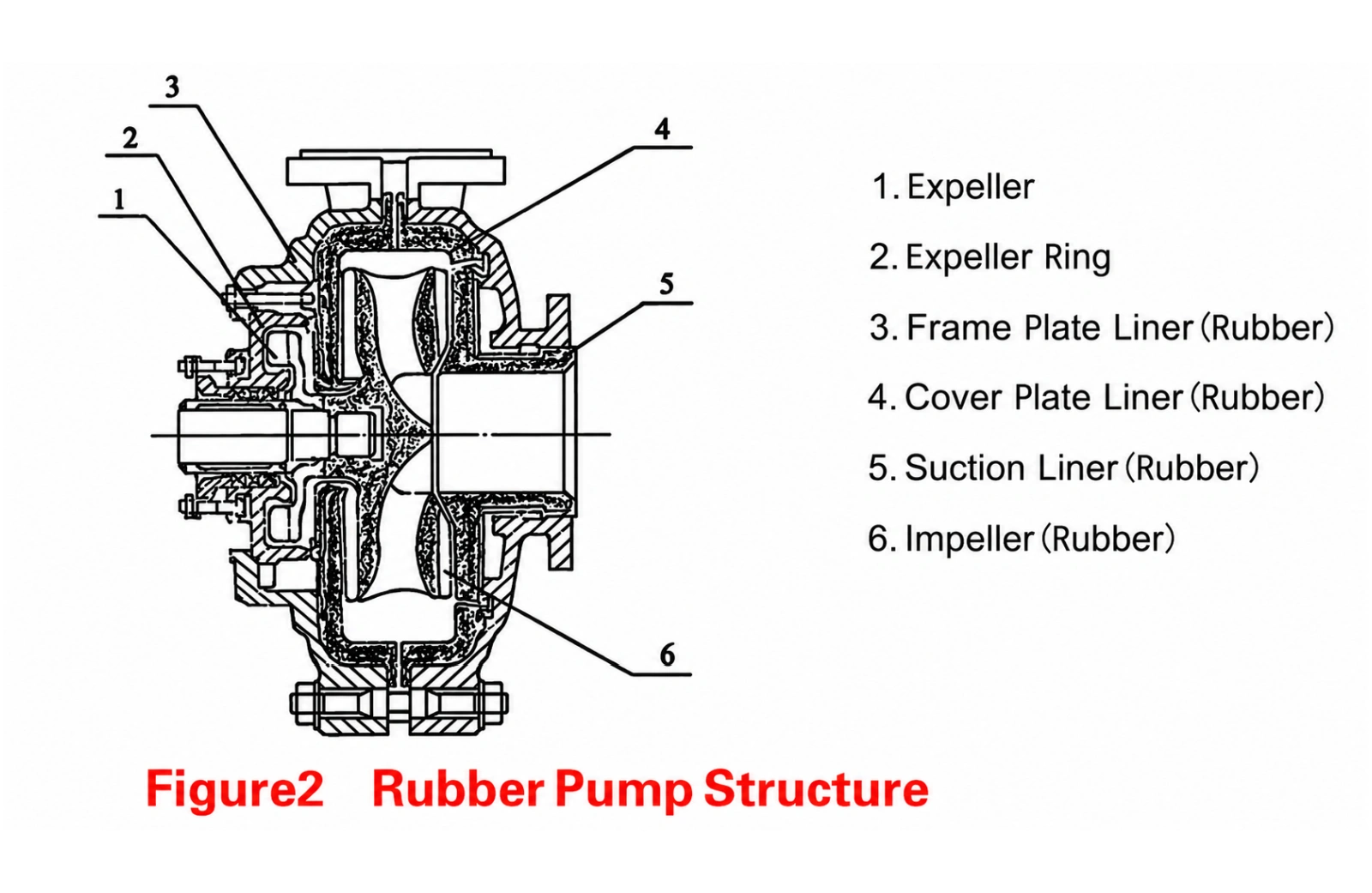
Fine, high-concentration slurry without sharp angular particles. Rubber also resists corrosion, which is why it appears in tailings and mineral-processing duty where the liquid phase is mildly aggressive.
Rubber has a temperature ceiling that metal does not, and it is not suitable where tramp material can enter the pump. For spillage and floor-drainage sumps, where what falls into the pit is unpredictable, metal is often the safer default.
Polyurethane
Fine abrasives in sliding-wear service. It sits between the other two: better than rubber against some cutting action, without the weight and cost of a full metal wet end.
What wears first, and what that tells you
In a correctly selected pump the throatbush wears first. Velocity is highest at the inlet, so that is where erosion concentrates. Planning throatbush replacement as the routine wear item is normal.
If something else wears first, read it as a signal. Impeller or volute wear ahead of the throatbush usually means the pump is running away from its best efficiency point — throttled, oversped, or oversized for the duty. Changing to a harder liner will not fix a hydraulic mismatch; it will only postpone the symptom.
Practical points before you specify
- Both wet ends fit the same casing. On the SAH range, the metal and rubber builds share the pressure shell. Changing material later does not mean changing the pump.
- Rubber-lined pumps still have metal parts. Shaft, bearing assembly and casing are unaffected by the liner choice.
- Gravel and dredge pumps are single-shell. Not every pump in the range is a two-shell design; the liner options differ accordingly.
Send us the slurry data
Give us particle size distribution, particle shape, concentration by weight, pH and temperature, and we will come back with a liner recommendation and the wear-part list that goes with it.
Can I change from metal to rubber later?
On the SAH range both builds sit inside the same pressure casing, so the wet end can be changed without changing the pump, baseplate or drive.
Is the hardest liner always the longest lasting?
No. A49 is softer than A05 and A07 yet outlasts them in low-pH desulphurisation duty, because there corrosion resistance matters more than erosion resistance.
My impeller wears out before the throatbush. Why?
That order is usually a hydraulic signal rather than a material one: the pump is likely running away from its best efficiency point. A harder liner postpones the symptom without removing the cause.
Manufacturer-direct supply · Technical pump-selection support · Export documentation on request.