
Froth pump air lock prevention starts before the impeller. Flotation froth is fine-particle slurry with a great many small air bubbles spread through it, and getting it into the pump is the difficult step. On the SAHF froth pump, feed enters a hopper through a tangential inlet, and an overflow box helps clear returning froth and excess feed.
What causes air lock in a froth pump
With that much air in it, froth usually weighs less than water, and very little NPSH is available at the suction. The struggle happens at the impeller eye: froth resists going in, yet once it reaches the impeller the pump will usually move it on.
Air lock is the name for what happens when air builds up at the impeller eye and the froth stops moving into the pump.
One froth may be brittle and another tenacious, so base the pump choice on the hardest froth you expect to see.
Bigger intake, open impeller
Froth is difficult to pull into a pump, which is why a froth pump needs a large intake. Opening up the intake is a preferred fix: the wider it is, the more froth the impeller eye sees. An open impeller does the best job of swirling the froth at the intake.
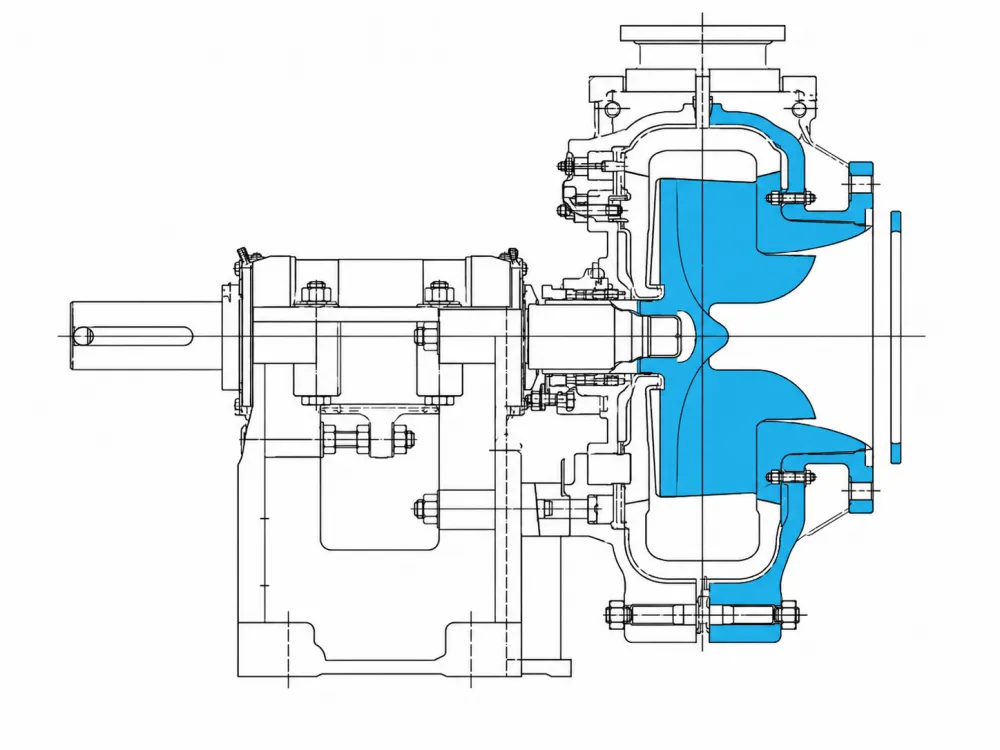
Very tenacious froth calls for a still larger inlet plus a flow inducer fitted in the intake.
The hopper: tangential inlet and overflow box
The SAHF froth pump is fed from a hopper. Feed enters through a tangential inlet, and an overflow box helps clear returning froth and excess feed.
Leave the hopper plenty of overflow capacity, and keep the incoming feed from dragging more air in. If the hopper is overflowing all the time, the froth pump cannot keep up. Keep spillage to a minimum, because the mineral product is in the froth.
Size for the froth, not the slurry
Froth takes up extra volume, so a froth pump has to be larger than the pump the same slurry would need without froth. Our manual sizes it on froth flow: Qf = FVF × Qs, where Qs is the slurry flow and FVF is the Froth Volume Factor for the froth type.
The factor depends on whether the froth is brittle, medium or tenacious, and it should not be taken above 1.8. The factor ranges are listed on our froth pump page. Size on the design flow, then confirm the choice still works at the maximum slurry flow. When unsure, go one size larger.
Keep the head low and the speed right
Keep the total head below 35 m. Running a froth pump too fast does more harm to its performance than almost anything else. When the pump is struggling with the froth, the usual answer is to slow it down rather than speed it up.
The SAHF froth pump is offered with DC direct drive or BD vertical belt drive. On belt drive, the speed can be changed by fitting different pulleys. If the froth properties change, a variable speed drive is the better choice.
SAHF range
| Model | Flow (m³/h) | Head (m) |
|---|---|---|
| 3/2C-SAHF | 20–80 | 8–32 |
| 4/3D-SAHF | 50–200 | 10–52 |
| 6/4D-SAHF | 100–300 | 10–70 |
| 8/6E-SAHF | 200–800 | 10–40 |
| 2QV-SAHF | 50 | 30 |
Values are for preliminary selection only. The 2QV-SAHF is listed at a single point.
The table lists heads above 35 m for some sizes. For froth duty, keep the total head below 35 m.
Wet-end materials
High-chrome alloy wet ends as standard; rubber wet ends can be supplied.
What to send us
Tell us the froth type (brittle, medium or tenacious), the design and maximum slurry flow, the solids concentration and the head you need. An engineer replies within 24 hours.
FAQ
How is froth flow worked out?
Multiply the slurry flow by the Froth Volume Factor for your froth type: Qf = FVF × Qs. Do not use a factor above 1.8.
Should I speed the pump up if the froth is not moving?
No. Running too fast hurts froth pumping, and slowing the pump down is normally the right move.
What does a hopper that keeps overflowing mean?
It means the froth pump cannot keep up. Keep spillage to a minimum, because the mineral product is in the froth.