
Choosing a tailings pump is mostly a materials decision. The hydraulic duty sets the size; what the slurry does to the wet end sets the service life. If the material is wrong, you will be replacing liners on a pump that was sized correctly.
Tailings duty is not ordinary slurry duty. Concentrations run high, the solids are angular, and the line runs continuously. A pump that survives a mill discharge line for a year can be worn through in months on a thickened tailings line at the same flow. That is why we ask for five numbers before quoting anything.
What we need from you
Flow rate, in cubic metres per hour. Total head, in metres, including static lift and friction loss over the full pipeline. Solids concentration, by weight or by volume, whichever you measure. Particle size distribution, or at least d50 and top size. Slurry pH.
Those five decide the tailings pump size. The fourth and fifth decide the material, and the material decides how often you shut the line down.
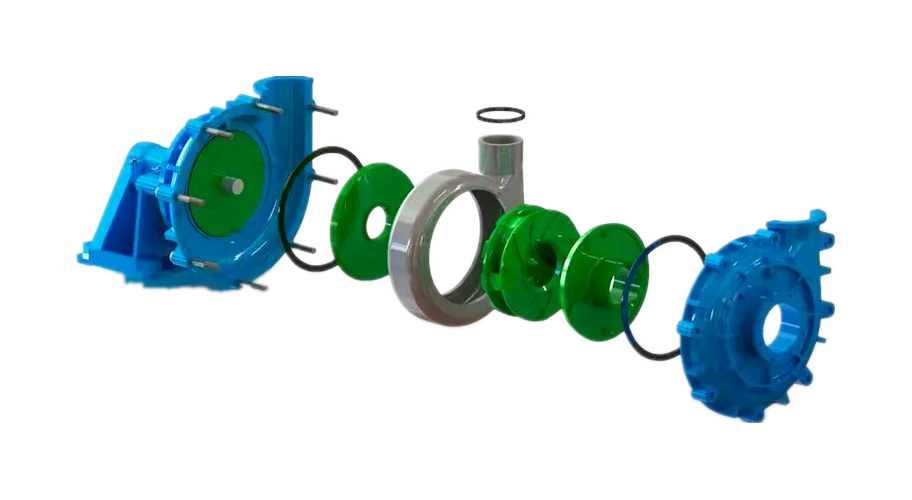
Matching tailings pump material to the slurry
Our wet ends come in four material families: high chrome alloy, rubber, polyurethane and ceramics, with the metal wet ends cast in house. Within high chrome, the grade matters more than the family name.
A07 (KmTBCr15Mo) has the best erosion resistance in the range and is the default for coarse, high-impact abrasive duty. Its hardness is HRC 58 to 70. Where the slurry is also corrosive, A07 is not the strongest choice.
A05 (KmTBCr27) trades a little erosion resistance for corrosion resistance, with tensile strength from 700 MPa and hardness from HRC 62. It is specified for pH 5 to 12.
A49 is the grade for low pH. It holds up in flue gas service and in desulphurisation duty down to pH 4.
A33 goes further down the scale, handling oxidising slurries to pH 1, including phosphogypsum and mineral acids.
A11 (KmTBMnMo) sits at HRC 38 to 42. It is softer on purpose, so it can be drilled and tapped, and it suits fine-particle duty with light abrasion.
If your tailings pump is running a neutral, coarse line, the conversation starts at A07. If it is acidic, it starts at A49 or A33. Rubber and polyurethane are worth considering when particles are fine and rounded, but they lose to metal on top size and on temperature.
| Grade | Hardness | pH window | Best for |
|---|---|---|---|
| A07 (KmTBCr15Mo) | HRC 58-70 | – | Coarse, high-impact abrasive duty |
| A05 (KmTBCr27) | from HRC 62 | 5-12 | Abrasive duty with some corrosion |
| A49 | – | ≥ 4 | Flue gas, desulphurisation |
| A33 | – | ≥ 1 | Oxidising slurries, mineral acids |
| A11 (KmTBMnMo) | HRC 38-42 | – | Fine particles, light abrasion; machinable |
What our tailings pump range covers
The horizontal series runs from 1 inch to 24 inch discharge, which is 25 to 600 mm. Flow from 5 to 5000 cubic metres per hour. Head from 10 to 120 metres. Drive power from 30 to 1200 kW, at 720, 990, 1480 or 2960 rpm. Frame sizes B through T. Drive arrangements cover belt, direct coupled and both vertical and horizontal gearbox layouts.
The series is built for strongly abrasive, highly concentrated slurry. Tailings sits inside that envelope at almost every plant size.
What a catalogue cannot tell you
A tailings pump model cannot be picked from a web page. Two plants moving the same tonnage of the same ore can need different tailings pumps, because one runs 18 hours and the other runs 24, or because one has 40 metres of static lift and the other has 400 metres of pipe.
Wear life depends on your solids, speed and duty point, so we do not quote it in hours. Instead, we tell you which grade we would cast for your slurry, and why.
Where we cast
Tailings pump wet ends are poured in our own foundries. Six medium-frequency induction furnaces, 35 tonnes of total capacity, 18,000 tonnes of castings a year, across four production bases. For tailings work, it means that when a liner set wears out sooner than expected, we can change the grade and re-cast rather than leave you with it.
Common questions
How do I know which model, material and sealing type to choose?
Send the five numbers above. We size the tailings pump from the duty point, pick the grade from pH and particle size, and pick the seal from your available gland water and pressure. We do not ask you to work it out from a catalogue.
What is the real wear life of your high-chrome wet end?
It depends on your slurry, so we do not quote it in hours. What we can tell you is the grade, its hardness and its pH window, and we will re-cast in a different grade if the first choice under-performs on your line.
Can you handle acidic tailings?
Yes, with the right grade. A49 covers duty down to pH 4. A33 handles oxidising slurries to pH 1.
Send us five numbers
Flow, head, concentration, particle size, pH. One of our engineers will come back to you within 24 hours with a duty point, a material recommendation and a drawing.