
On a sand dredging line, the largest particle your sand dredge pump must pass decides the model before flow rate does. If the pump cannot pass your largest stones, it will block, whatever the duty point.
Our WN series sand dredge pump passes solids from 144 mm to 354 mm depending on model.
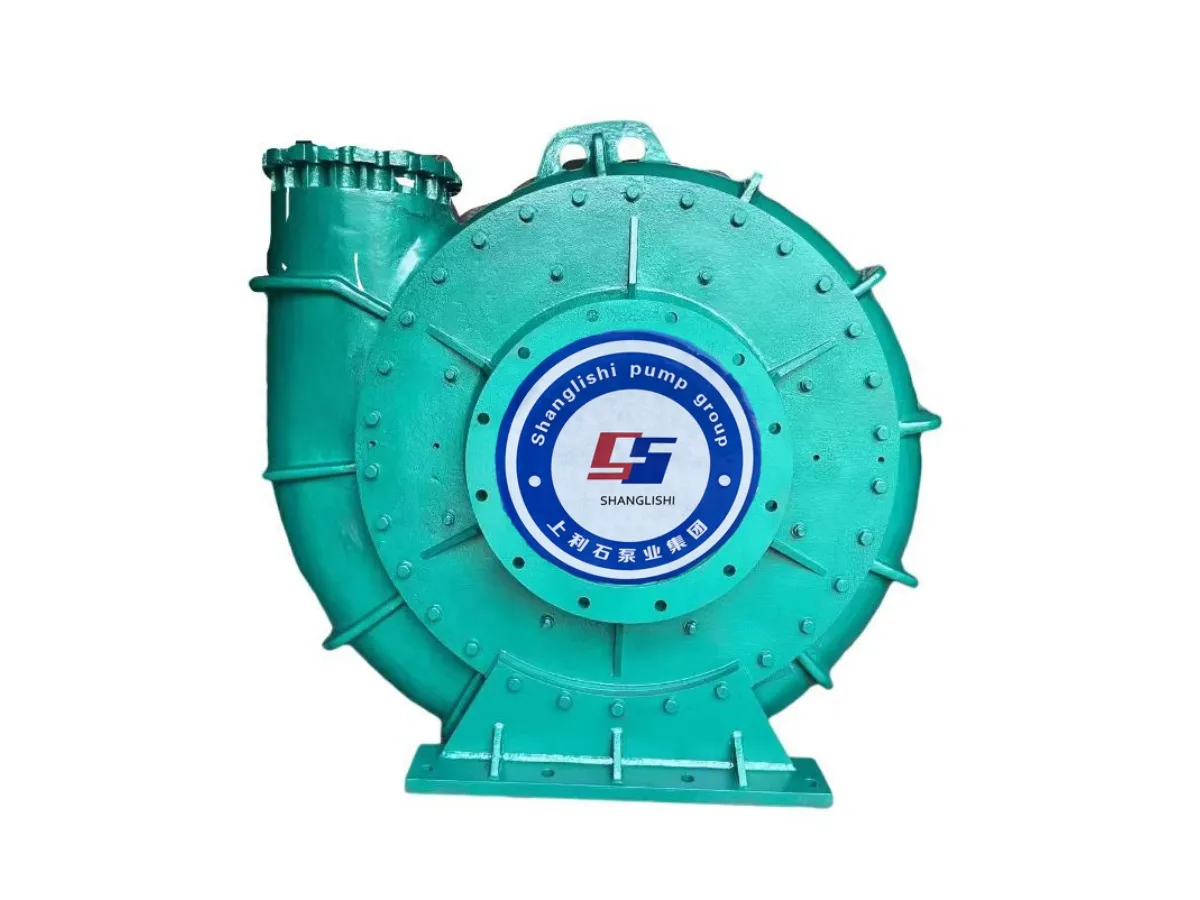
What our sand dredge pump range covers
Fifteen models, from 200WN to 1000WN. Flow from 600 to 25,000 litres per second. Head from 20 to 85 metres. Efficiency from 60 to 87 per cent. Required NPSH under 4 metres on the smaller models and under 6 metres on the large ones. Inlet from 250 to 1200 mm, outlet from 200 to 1000 mm.
A few examples of how particle size tracks with size. The 200WN passes 180 mm at 750 to 1000 l/s. The 300WN passes 241 mm at 1800 to 2200 l/s. The 500WN passes 250 mm at 4500 to 5500 l/s. The 700WN passes 280 mm at 8000 to 12,000 l/s. At the top of the range the 1000WN moves 16,000 to 25,000 l/s and passes 350 mm.
Note that particle size does not rise in a straight line with pump size. The 450WN passes 354 mm, which is larger than anything the 500WN, 600WN or 700WN will take. The 250WN passes 144 mm while the 250WND next to it passes 220 mm. If your sand contains occasional cobbles, tell us the top size and we will work from that, not from the flow.
| Model | Capacity (l/s) | Head (m) | Speed (rpm) | Eff. (%) | NPSHr (m) | Inlet (mm) | Outlet (mm) | Max particle (mm) |
|---|---|---|---|---|---|---|---|---|
| 200WND | 600-800 | 20-40 | 700-900 | 60-65 | <4.5 | 250 | 200 | 178 |
| 200WN | 750-1000 | 40-65 | 700-850 | 70-72 | <4 | 250 | 200 | 180 |
| 250WND | 950-1100 | 20-40 | 500-700 | 65-70 | <4 | 300 | 250 | 220 |
| 250WN | 1100-1300 | 40-65 | 500-650 | 70-74 | <4 | 350 | 250 | 144 |
| 300WND | 1500-1800 | 20-40 | 400-600 | 65-68 | <4 | 350 | 300 | 241 |
| 300WN | 1800-2200 | 40-65 | 400-550 | 74-78 | <4 | 450 | 300 | 241 |
| 350WN | 2600-3000 | 40-65 | 400-550 | 74-78 | <4.5 | 450 | 350 | 245 |
| 400WN | 2800-3200 | 20-40 | 400-550 | 74-78 | <4.5 | 450 | 400 | 250 |
| 450WN | 3200-3850 | 40-67 | 350-500 | 76-80 | <4.5 | 600 | 450 | 354 |
| 500WND | 3600-4200 | 20-40 | 220-320 | 72-75 | <4.8 | 600 | 500 | 330 |
| 500WN | 4500-5500 | 40-65 | 350-450 | 78-80 | <4.8 | 650 | 500 | 250 |
| 600WN | 5000-9000 | 55-80 | 280-420 | 81-85 | <6 | 660 | 600 | 220 |
| 700WN | 8000-12000 | 60-85 | 280-380 | 83-85 | <6 | 760 | 700 | 280 |
| 900WN | 12000-19000 | 50-75 | 280-330 | 85-87 | <6 | 960 | 900 | 320 |
| 1000WN | 16000-25000 | 23-76 | 181-290 | 85-87 | <6 | 1200 | 1000 | 350 |
Single casing or double casing
Below 500WN the pumps use a single casing, single stage, single suction cantilever layout. You can have the drive as a self-contained bearing assembly or as a combined pump-and-housing unit. Shaft sealing is mechanical, packing, or the two combined.
From 600WN up the design changes to a double casing. On a dredger this has a practical benefit: the liner can be run until it is almost worn through, and if the liner does crack, the pump room does not flood.
There is also a submerged version, the WNQ, built as a single casing cantilever pump with either oil or water lubrication for the bearing assembly.
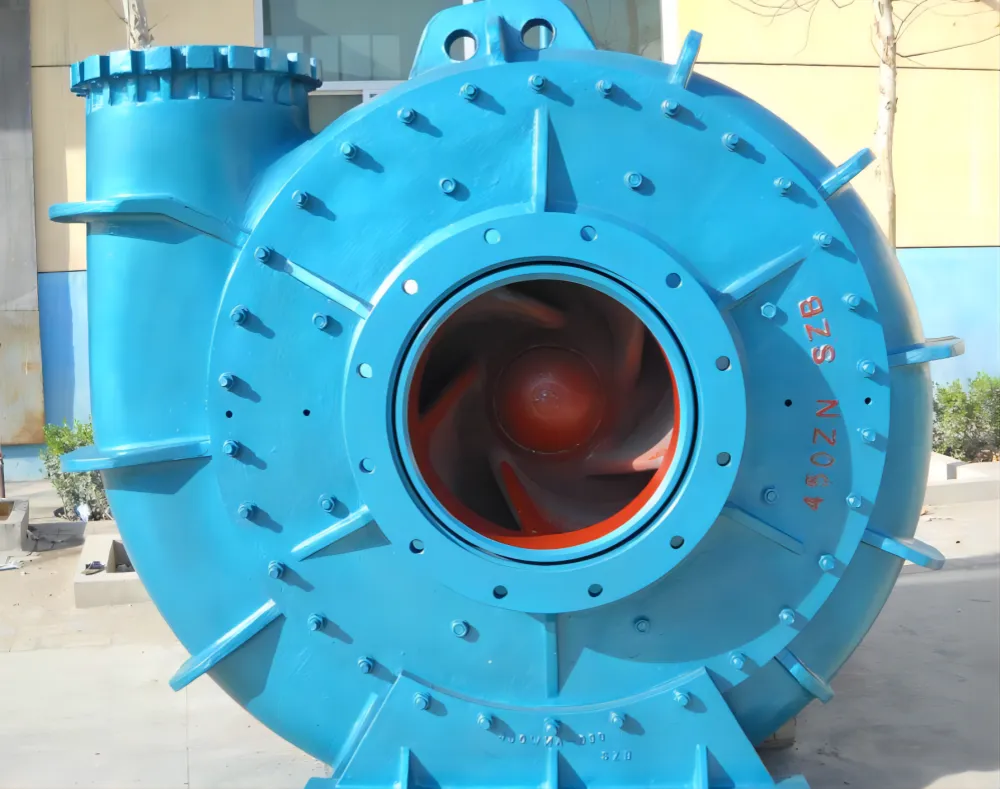
Why a sand dredge pump of this design does not block
The impeller passage is wide. The series is built to move gravel or high-plasticity clay continuously rather than in bursts. Cavitation behaviour is good, which is what lets a dredger work at greater depth and draw a higher solids concentration without losing suction.
The head-capacity curve is steep. In practice that means the pump copes better when discharge distance changes, which on a working dredger it does constantly.
If you need a different head at the same flow, we change the impeller diameter or the speed rather than move you to another model.
Wear parts and hardness
Impeller, liner and the front and rear plates are cast in high-chrome alloy at HRC 58 to 70. The parts are matched so that their replacement intervals line up, which keeps you to one shutdown instead of three.
The pump is a front pull-out design, so the wet end comes apart from the suction side without disturbing the drive or the pipework behind it. It ships with the tools made for that job.
The impeller is joined to the shaft with a four-start trapezoidal thread. Four starts carry the torque a dredging duty puts through the shaft, and let the impeller come off in a quarter turn. A removal ring at the shaft sleeve does the same job for the sleeve. These features do not change wear life, but they shorten the time the vessel sits idle during a change-out.
Certification
Every unit in the series is inspected and certified by the China Classification Society.
What we need from you
Top particle size. Flow in litres per second or cubic metres per hour. Total head including the discharge line. Dredging depth. Solids concentration. Whether the pump sits on deck or underwater.
Common questions
Can a sand dredge pump handle gravel and cobbles without blocking?
Within the rated particle size, yes. The impeller passage is wide and the series is designed for continuous sand and gravel dredging rather than clean water with occasional solids. Send us the top size and we will confirm the model against it.
How long do the wear parts last, and do I replace them one at a time?
Wear life depends on your sand, your speed and your duty point, so we do not quote it in hours. What we do is match the life of the impeller, liner and plates so they wear out together. That gives you one planned shutdown rather than three unplanned ones.
What if the liner wears through on a dredger?
On 600WN and above the double casing means the pump room stays dry if the liner cracks. That is why the larger models use a double casing.
Send us your top particle size and we will size the sand dredge pump
Top size, flow, head, depth, concentration, and whether the pump is on deck or submerged. One of our engineers will come back within 24 hours with a model, a duty point and a drawing.