
A ceramic slurry pump is the right choice when your slurry attacks the wet end two ways at once: it wears the parts and corrodes them. That is the duty our SAZP series was developed for, in metal and non-metal ore dressing plants.
If your slurry is abrasive but close to neutral, start with our metal wet ends. Ceramic makes sense where abrasion and corrosion occur together.
Why silicon carbide lasts
The wetted parts are sintered ceramic: silicon carbide bonded with silicon nitride. Silicon carbide is second only to diamond in hardness. In a comparison test by Xi’an Jiaotong University, its wear resistance was 3.51 times that of Cr30 wear-resistant steel.
That was one material against one steel grade, so read it as a material comparison rather than a service-life figure.
Chemically, it resists almost all inorganic acids, organic acids and alkalis. The exceptions are hydrofluoric acid and hot concentrated alkali. It also stands up to impact from large particles and steel balls, and it works from minus 40 to 90 °C in continuous service, with a maximum of 110 °C.
At one customer site, ceramic wet ends have run for more than five years, against two to three years for metal pumps, with about 15% lower energy consumption. Results on other duties may differ.
Where we would not use a ceramic slurry pump
Hydrofluoric acid and hot concentrated alkali are outside what silicon carbide tolerates, so we will not offer a ceramic wet end for either. The same applies to slurry above 110 °C, or slurry that stays above 90 °C for long periods.
Service life on your line will depend on your solids, chemistry and duty point, so we do not quote it in hours.
How the SAZP is put together
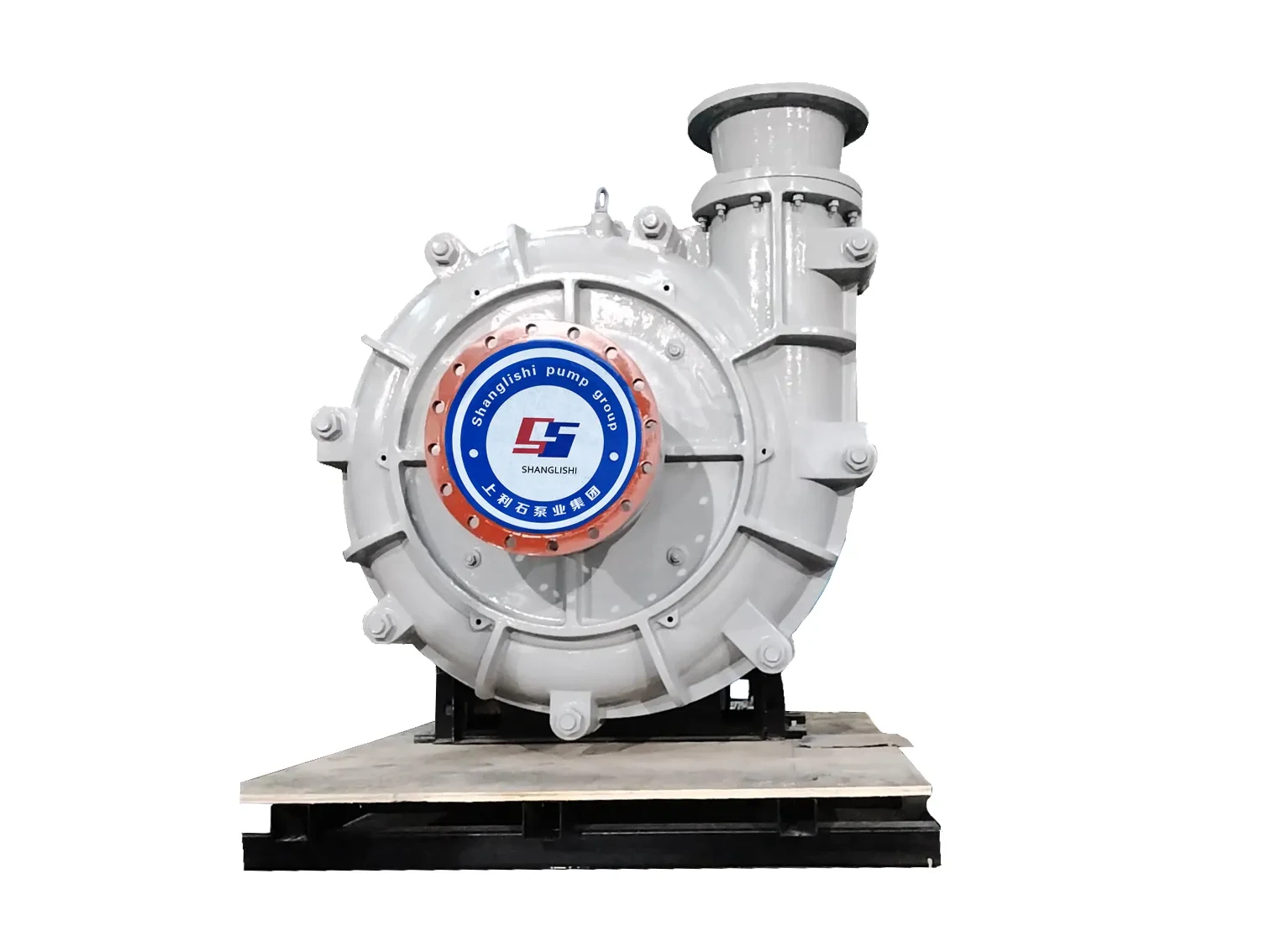
Four parts carry the slurry, and all four are silicon carbide: the front guard plate, the impeller, the pump body and the rear guard plate. The pump head is split and bolts to the bracket. The outlet angle can be turned as needed, which also allows multi-stage connection.
The standard shaft seal is an expeller with packing, the common arrangement in mineral processing. Where a mechanical seal is used, it has an external spring, which keeps it from clogging. Bearings are grease lubricated, which avoids the oil leaks of thin-oil lubrication.
An adjusting bolt on the bracket moves the bearing housing axially, so the impeller clearance can be reset to keep the pump near its efficiency point. The bearing position has a temperature measuring device, so readings can go to your site DCS. Overall installation dimensions and accessories are interchangeable with metal slurry pumps.
The SAZP is our own design, covered by patents ZL2021219163720 and ZL202121915677X. We are also a drafting company of the group standard for centrifugal ceramic slurry pumps.
What the SAZP range covers
The table below is the current SAZP ceramic line.
| Item | SAZP |
|---|---|
| Inlet and outlet diameter | 1 to 24 in (25 to 600 mm) |
| Head | 10 to 120 m |
| Speed | 720, 990, 1480 and 2960 rpm |
| Power | 30 to 1200 kW |
| Main sizes | 1½/1, 2/1½, 3/2, 4/3, 6/4, 8/6, 10/8, 12/10, 14/12, 16/14, 18/16, 20/18, 24/20, 24/22, 28/24 |
| Frame types | B, C, D, E, F, G, ST |
| Medium | Strongly abrasive, high-concentration slurry |
| Max solids by weight | Ash slurry 45%, ore slurry 60% |
Send us the duty and we will select the size and speed for it.
What to send us for a ceramic slurry pump quote
For a quote we need six things: flow, head, suction pressure, the medium, solids content and your seal preference. Particle size, density, viscosity, NPSHa, drive type and whether the pump runs continuously or intermittently all sharpen the answer.
For ceramic, add slurry temperature and pH, and tell us if anything in the stream is hydrofluoric or hot and strongly alkaline. Those decide whether ceramic is right before we size anything.
Check if ceramic fits your slurry
FAQ
Metal, rubber, polyurethane or ceramic: which wet end suits my slurry?
It depends on what the slurry does to the parts. Our metal grades cover heavy abrasion, and two of them are made for low pH: A49 down to pH 4 and A33 down to pH 1 for oxidising slurries. Our horizontal pumps can also take rubber liners, which resist wear and corrosion.
Ceramic covers abrasion and corrosion together, within the limits above. We have no comparison figures for polyurethane to publish, so we will not rank it here.
Can a ceramic slurry pump replace my metal pump on the same installation?
The SAZP’s overall installation dimensions and accessories are interchangeable with metal slurry pumps. Tell us the pump you run now and we will check the match.
How do I keep a ceramic slurry pump efficient as the parts wear?
Use the adjusting bolt on the bracket. It moves the bearing housing axially so you can reset the impeller clearance and bring the pump back toward its efficiency point.
Not sure ceramic is worth it on your line? Send us the slurry details. Our engineers reply within 24 hours, and if metal suits your duty better, we will recommend it.