
A vertical sump pump for slurry is a different job from a clean water or sewage sump pump. Our SSP(R) is submerged in liquid and is used for transporting abrasive, coarse-grained, highly concentrated slurries.
It does not require any shaft seal or shaft seal water, and it can operate under inadequate suction conditions.
That leaves four decisions: the inlet, the length, metal or rubber, and the drive. Each one depends on your sump.
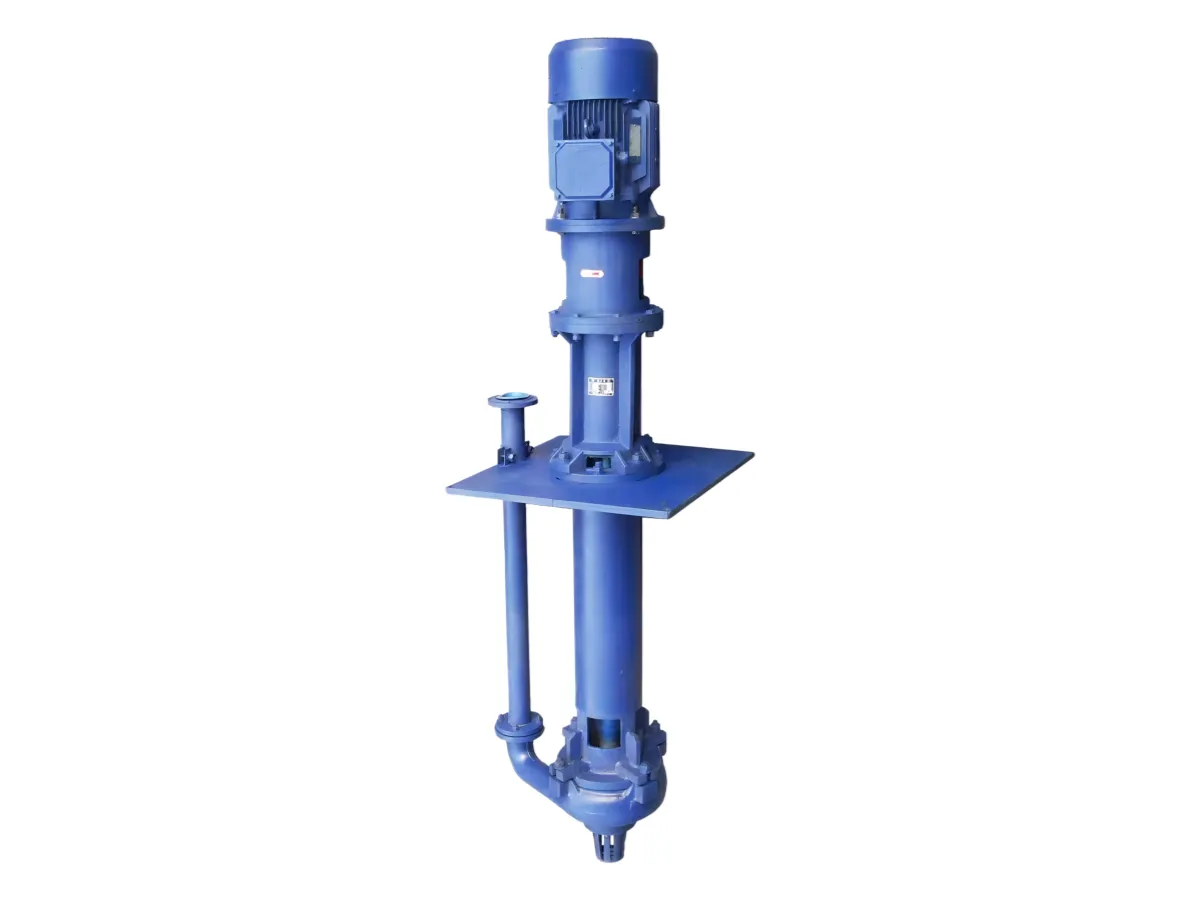
How the pump sits in your sump
The wet end works submerged in the slurry. Parts on the pump include the column, discharge pipe, strainer, lower strainer, middle support parts, frame plate, bearing assembly, impeller and back liner.
Choice 1: the inlet
The SSP(R) comes with three inlet structures: standard with strainer, suction pipe with strainer, and agitator type.
Tell us whether solids settle between runs and how far the level moves, and we will recommend one.
Choice 2: standard or extended length
Models with L in the name are extended length types, suitable for deeper liquid. They add a guide bearing structure, and flushing water is required in the guide bearing area. Standard and extended lengths each have their own dimensions.
So a deeper sump buys you reach but brings back a water line at the guide bearing. If the standard length reaches your working level, there is no guide bearing to flush.
This is the extended build of the SSP(R), not the SZPL. The SZPL has no shaft seal, and we cover it in our guide to a vertical slurry pump without seal water.
Choice 3: metal or rubber in the sump
The SSP has all metal parts and is used for transporting abrasive slurry. The SSPR is rubber-protected and is used for transporting acidic abrasive slurry. We have SSPR duty figures for the 40, 65 and 100 mm sizes. If you are still deciding between the SSP, SSPR and SZPL, our guide to the vertical centrifugal slurry pump compares the three.
Send us particle size and pH with your enquiry and we will confirm the wet end. The rubber-lined vertical slurry pump page shows the SSPR.
Choice 4: belt or direct drive
The SSP(R) can be arranged with a pulley belt connection or a direct connection.
Which one suits depends on the speed you need and the room above your sump. Tell us both and we will propose the arrangement.
Vertical sump pump sizes and duty ranges
| Model | Outlet (mm) | Flow (m³/h) | Head (m) |
|---|---|---|---|
| 65QV(L)-SSP | 65 | 23.4–111 | 5–29.5 |
| 100RV(L)-SSP | 100 | 54–289 | 5–35 |
| 150SV(L)-SSP | 150 | 108–479.16 | 8.5–40 |
| 250TV(L)-SSP | 250 | 261–1089 | 7.5–33.5 |
Figures are clear water performance for the metal SSP. The full table is on our SSP(R) product page. For the 40, 200 and 300 mm metal sizes, the ranges are 19.44–43.2 m³/h at 4.5–28.5 m head, 189–891 m³/h at 6.5–37 m head and 288–1267 m³/h at 6.5–33 m head.
Vertical or submersible?
A submersible slurry pump goes into the sump motor and all. Our mining submersible pump guide covers that option. Send us the sump and we will tell you which we would quote. For duties beyond the table, we look at a horizontal pump.
What to send us
For a vertical sump pump quote, give us the distance from the mounting plate to the lowest liquid level and to the pit floor, flow and head, solids content, particle size and pH, whether solids settle between runs, and your drive preference.
Our engineers reply within 24 hours. The full range of vertical slurry pumps is on one page.
FAQ
Which build is meant for acidic slurry?
The SSPR is rubber-protected and is used for transporting acidic abrasive slurry. The SSP has all metal parts and is used for abrasive slurry. Send us your pH and particle size and we will confirm the build.
What does “inadequate suction conditions” mean for my sump?
It means the SSP(R) can keep working when suction is poor. It does not mean the pump can run dry, so tell us your lowest working level.
Which inlet should I choose?
There are three: standard with strainer, suction pipe with strainer, and agitator type. Send us your sump conditions and our engineers will recommend one.